

Every gifting catalogue in India now has a green page. Jute bags, bamboo bottles, seed-paper cards, cork diaries. All of it shot on linen with a leaf icon in the corner.
Almost none of it carries a certificate. “Eco-friendly” has no legal meaning by itself, so any vendor can print it on a box.
Sustainable corporate gifts do exist. There are labels that prove it, and knowing which ones count turns a vague green claim into a question your vendor can either answer or dodge.
Let’s start with what the word is meant to mean.
What makes a corporate gift sustainable?
Four things decide it. What it is made of is only one.
A bamboo bottle wrapped in plastic, used twice, then binned is worse than a plain steel one somebody carries for five years.
India’s own definition is broader than most vendors let on. The Central Pollution Control Board describes an environment-friendly product as one made, used or disposed of in a way that significantly reduces the harm it would otherwise cause the environment.
Read that again. It covers the whole life of the thing.
- Material: What the item is made from, and whether that input was grown, recycled or mined.
- Lifespan: How long somebody keeps it, which is the part catalogues skip.
- Packaging: What it arrives wrapped in, including the outer carton nobody shoots.
- End of life: Whether it can be recycled, composted or repaired once it stops being useful.
The official criteria work the same way. CPCB says its Ecomark criteria follow a cradle-to-grave approach, from raw material extraction, to manufacturing, to disposal.
So a gift is green across its whole life, or only in the photograph.
Which eco labels actually mean something?
Four do the work in India. One phrase does none.
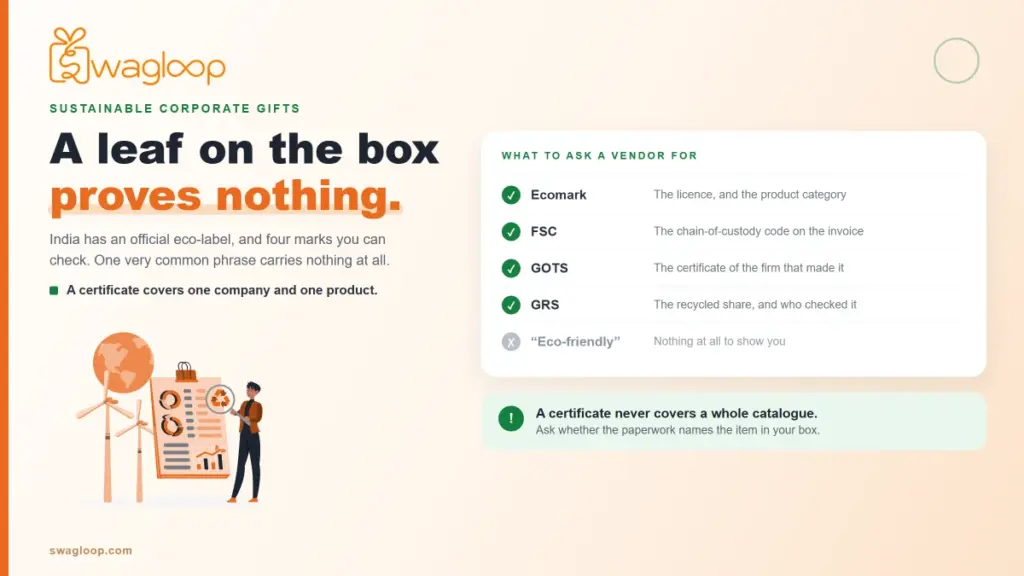
A label backed by a certificate can be checked. A leaf printed on a box cannot.
| Claim on the product | What it actually covers | What to ask the vendor for |
|---|---|---|
| Ecomark | India's official eco-label, judged cradle to grave | The licence, and the product category it covers |
| FSC | Paper and wood tracked through the supply chain | The chain-of-custody code on your invoice |
| GOTS | Organic textiles at every processing step | The certificate of the firm that made the item |
| GRS | Recycled content in a material | The percentage, and who checked it |
| "Eco-friendly" printed on the box | Nothing at all | A certificate, which usually ends the chat |
That last row is where most gifting budgets meet greenwashing.
Ecomark, the one nobody mentions
India launched Ecomark in 1991. The scheme now runs under rules refreshed in 2024, which put the Central Pollution Control Board in charge alongside the Bureau of Indian Standards.
It covers the kinds of goods you buy gifts from.
- Paper, textiles and leather.
- Packaging materials and plastics.
- Cosmetics and coir products.
We have yet to see one rival gifting page name it. That is odd, because it is the only eco-label in this market with the Indian government standing behind it.
What certification actually proves
A certificate attaches to one company and one product. It never covers a whole catalogue, and that gap is the trick worth watching for.
FSC is clear about it. Chain of custody certification is how the Forest Stewardship Council verifies that forest-based materials are credibly used along the product’s path from the forest to becoming finished goods.
GOTS is stricter. To sell a product as GOTS-certified, each company involved in processing it must be certified by an approved independent certification body.
Two claims that sound alike, and only one is about your gift.
- “Our supplier is GOTS certified” describes a factory somewhere in the chain.
- “This t-shirt is GOTS certified” describes the thing in the box.
Ask which one you are being told.
Which sustainable gifts do employees keep?
The useful ones, in the same share as any other gift. Making an item recycled does not make anybody want it.
A jute bag in a cupboard has the same footprint as a jute bag in a bin.
Keep-versus-bin decides the real result here. An item used weekly for three years has earned its material. One admired for a day has not.
- A good bottle or coffee cup gets used daily and survives years of it.
- A cotton tote gets used if it can carry groceries, and ignored if it sags.
- Seed paper and plantable cards feel thoughtful and are gone within a week.
- Bamboo desk items suit people who work at a desk, which is worth checking first.
We ran a campaign for a Gurgaon tech firm that ordered 400 recycled-cotton totes. Eleven months later their office manager still had 60 in a store cupboard, because headcount came off an old sheet. The bags were real and certified. A third of the order never reached a person.
That is the honest version of green gifting. Ordering close to headcount does more good than upgrading the fabric, which is why letting employees choose cuts waste faster than any certificate. The same logic drives what new hires keep in a welcome kit.
What does sustainable packaging really involve?
More than the box in the product photo. A gift wrapped beautifully, then dropped inside a plastic-taped carton, has a plastic problem nobody signed off on.
Work through it in the order a parcel gets built.
- The inner filler: Paper shred and moulded pulp replace plastic beads and bubble wrap, and they protect just as well when the box is sized well.
- The gift box: Uncoated board recycles. Board with a gloss coat does not, and it is the upgrade vendors suggest most.
- The print finish: Foiling and plastic coating look posh and make a box harder to recycle. Ask what the finish is made of.
- The tape and labels: Paper tape and one label beat three layers of plastic and a sleeve.
- The outer carton: The piece nobody looks at, and the largest bit of packaging in the order.
Box size does more than any material swap.
A box with 40% air in it costs more to ship, arrives dented, and burns fuel carrying nothing.
There is a legal angle worth knowing. Larger brands in India carry duties for the plastic packaging they put on the market, so this is not purely a taste question. Your buying team may already have a rule about it.
Ask for a photo of a packed parcel before you approve a run. The catalogue shot shows the gift. The parcel shows the packaging.
What should you ask a gifting vendor before you order?
Five questions. You learn most of what you need from how fast they answer.
A vendor with certificates has them to hand. A vendor without them talks about how well the product sells.
| Ask this | A real answer sounds like | A weak answer sounds like |
|---|---|---|
| Which certificate does this item hold? | A named standard and a licence number | Our whole range is eco-friendly |
| Can you send it across? | A PDF naming the company and product | The supplier has it, we can check |
| What is the packaging made of? | Named board, filler and tape | Fully sustainable packaging |
| What happens to unused stock? | A clear answer on returns or reuse | We can store it for you |
| Where is it made? | A place and a factory relationship | Through our partner network |
Notice the pattern in the weak column. Every answer moves the claim one step away from the thing you are buying.
Two of those answers count more than the rest. A certificate naming the exact product is the only proof that survives a second look. Leftovers tell you whether a vendor plans to oversell you.
Comparing suppliers on this is the point of any honest look at corporate gifting companies in India.
Now the awkward part. We do not hold certificates for every item on our platform. Where a product has none, we say so rather than calling it eco-friendly. Any vendor claiming certification across a whole catalogue is describing something the standards do not allow.
Does sustainable gifting cost more per head?
On some items yes. On others nothing at all. The honest answer depends on what you were going to buy anyway.
Packaging is where green choices are usually free or cheaper. Plain board and paper filler cost less than coated board and plastic beads, and a properly sized box cuts your shipping bill.
Materials are where the extra cost sits.
Organic and graded recycled inputs cost more than plain ones. The paperwork carries a fee too.
- Free or cheaper: Packaging swaps, box sizing, dropping plastic sleeves and extra print finishes.
- A little extra: Recycled paper products, and natural materials like jute and cork.
- A real extra: GOTS organic apparel, certified recycled textiles, Ecomark-licensed goods.
- Cheapest of all: Ordering closer to headcount, which costs nothing and saves the most.
So where does that leave a fixed budget? Usually with a choice between a certified item for fewer people and a good uncertified one for everybody. Why you are gifting decides it.
Setting the per-head gifting budget before you shop keeps that decision honest. Festive runs feel the squeeze most, since volumes are high and margins thin, which shows up in Diwali corporate gifts and in how Diwali hampers get costed by band. At bigger volumes the packaging savings start funding the material upgrade, which is the pleasant surprise in gifting for 500+ employees.
Conclusion
Green gifting gets simpler once you stop shopping for adjectives and start asking for paperwork. Pick items people will keep, order close to your real headcount, fix the packaging, and ask every vendor for a certificate that names the product rather than the range. Where branding is involved, custom branded gifts need the same question asked of the print and the finish.
What would your last gifting run have looked like if you had asked for one licence number? If you want options that come with an honest answer either way, see how Swagloop works and set your brief and budget.
Frequently Asked Questions
Are jute bags always the sustainable choice?
Jute grows fast and breaks down well. The finish decides it. Many jute bags carry a plastic laminate inside for stiffness, which makes them far harder to recycle later.
Is plantable seed paper a real gift or a token?
Seed paper works as an add-on and struggles as the main event. People enjoy it, plant it or lose it, then remember whatever stayed on the desk. Use it for the card.
What do you do with leftover eco gifts after a campaign?
Hold them for new joiners, since a welcome kit absorbs surplus neatly. Gifts get assembled per campaign with no stock held between runs, so extras stay with you. Order closer to headcount and the problem never starts.
Do sustainable gifts take longer to produce?
Graded fabric or board can add time when it has to be sourced. Standard delivery runs 12–14 working days across India. Ask at quoting stage rather than after approval, because swaps are where a certificate quietly vanishes from an order.
Should you tell employees the gift is sustainable?
Say it once, on the card, in one sentence. A gift that explains its own virtue at length reads as marketing, and people notice the gap between a paragraph about the planet and a plastic-wrapped parcel.