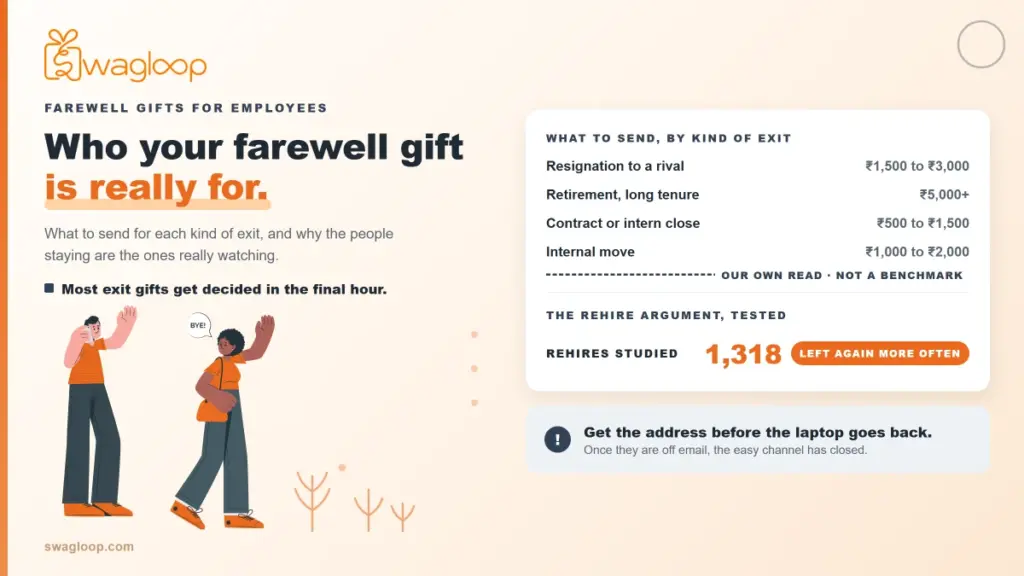


A pair of resignations landed in the same month last year. One team put together a ₹6,000 send-off with a hamper and a signed book. The other manager bought a card on the way in.
Same grade, same tenure, same company. Somebody in the second team noticed, and by the following week three people knew about it.
That gap is what a corporate gifting policy exists to close. You write one down so the same call gets made twice, even when the person making it is busy, new to the job, or just fonder of one employee than the other.
Most Indian firms have nothing written down at all. The rules live in the head of whoever has been in HR longest, which works fine until that person takes leave in the week before Diwali.
What Does a Corporate Gifting Policy Cover?
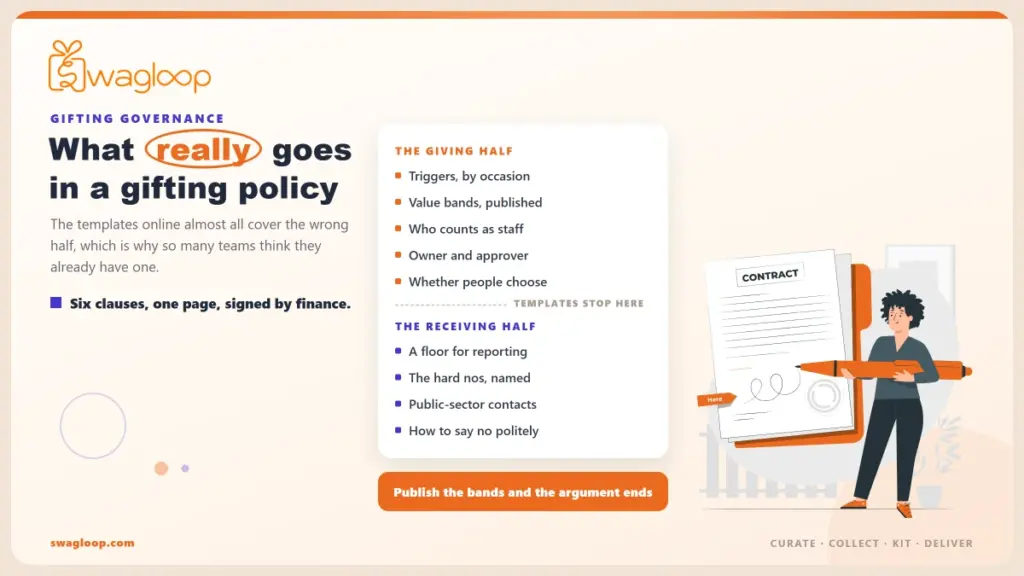
It covers two separate things, and the two get mixed up all the time. Search for a template online and you will mostly find the second one below, which is why so many firms think they already have a policy when they do not.
- The giving side. What your company sends to employees, clients, partners and vendors. Occasions, value bands, approvals, ownership.
- The receiving side. What your employees may accept from suppliers and clients. Thresholds, disclosure, refusals.
The receiving side is an ethics page and usually lives inside a code of conduct, where its job is to stop buying decisions being bought. The giving side is a working page, and it is the one no one writes.
Both need to exist. They answer to different people, so they rarely belong in the same paragraph even when they share a file.
Write them as two halves of one page.
Why the Giving Side Gets Skipped
No one treats gifting as a policy area until it goes wrong.
When it does go wrong, it takes one of three familiar shapes.
- A gap between teams, which reads as favouritism whether or not it was.
- A last-minute scramble, where the gift gets picked forty minutes before it is needed.
- A budget shock at year end, because no one added up what each team spent.
What Goes in the Giving Half?
The clauses below cover almost everything. Keep the whole thing to one page, because a page no one reads governs nothing.
| Clause | The question it settles | A workable default |
|---|---|---|
| Triggers | Which occasions get a gift at all | Joining, work anniversaries at set years, festivals, exit above a tenure floor |
| Value bands | How much, by occasion | A band per occasion, published, with a stated exception route |
| Who counts | Which staff the policy covers | Name contract and agency staff either in or out |
| Ownership | Who runs the order | One named owner per occasion, never the employee's own manager |
| Approval | What needs a second signature | Anything above the band, plus any client or government contact |
| Choice | Whether the recipient picks | Choice from an approved set wherever the volume allows |
Set the bands by occasion rather than by seniority. Grade-based bands look fair on paper and then produce the outcome no one wants, where a long-serving shop-floor employee receives less on a tenth anniversary than a manager receives in their first year.
Point it at your per-head gifting budget rather than restating the numbers, which only drift out of sync.
The Clause Most Policies Miss
Write down who is excluded and why. Contract staff, interns, notice-period employees and people on long leave all sit in a grey zone, and the grey zone is where the resentment forms.
- Contract and agency staff are the most common omission, and the most visible one on a shop floor.
- Notice-period employees need a stated rule, or every exit becomes a judgement call. Our page on farewell gifts goes through how exit type should drive that.
- New joiners inside 90 days at festival time need a written answer well before the festival rather than during it.
What Goes in the Receiving Half?
Shorter, stricter, and mostly about disclosure.
The aim is a rule your team can follow without ringing legal every time a client sends over a box of sweets.
- Set a floor for reporting. Anything above a stated value goes to a named person, whoever sent it.
- Name the hard nos. Cash, anything cash-like, and anything at all that turns up during a live tender.
- Treat public-sector contacts apart. Government service rules cap what an official may take, those caps bind them rather than you, so route any such gift through a second sign-off.
- Give people a way to say no politely. A one-line template saves more awkwardness than a rule ever will.
- Say what happens to a gift no one can keep. Pooling it for a staff raffle is the usual answer, and it belongs in writing before the first parcel lands.
The floor does more work than the ceiling. Teams follow a number they can remember, and they quietly ignore any rule that asks them to weigh up somebody else’s intent.
Who Approves the Spend?
Three roles sit behind every order, and mixing them up is what produces the year-end surprise. Name each one by job title rather than by person.
The requester is whoever notices the occasion. The owner runs the order and holds the budget line. The approver signs anything outside the band. In smaller companies one person may well hold two of those roles, which works fine as long as no one holds all three for their own team.
- Budget sits in one place, split by occasion, rather than inside each manager’s own spend.
- Orders get batched. One run a quarter for exits and anniversaries costs less and kills the scramble.
- Sign-off limits are published. A limit no one has seen gets tested every month.
Batching is the clause that saves real money, and it also handles a constraint worth stating plainly. One gift is never a bulk order, every real supplier holds a minimum quantity, and a rule written around one-off purchases will run at retail prices every single time.
Where Tax and GST Change the Policy
Finance usually raises one objection to a gifting budget, and generosity has nothing to do with it. The objection is about credit, because GST paid on these items cannot be recovered the way it can on most other business purchases.
The law is blunt about it. Input tax credit is blocked on goods disposed of by gift or free samples, under Section 17(5)(h) of the CGST Act. So the tax on a gifting order behaves as a cost rather than something you claim back later, and any budget built on the other assumption will come in short.
A second point deserves a line in the policy. The definition of supply in Section 7 of the same Act reaches certain listed activities “made or agreed to be made without a consideration”, which is why employer-to-employee transfers get looked at differently above certain values.
Keep tax figures out of the page itself. They change, and a stale number in a policy page is worse than no number at all. Name the two duties and point at wherever the current position is held.
- Assign the tax question to finance, in writing, so the gifting owner never guesses.
- Ask for a GST invoice on every order, even where credit is unavailable, because the record still matters.
- Review thresholds annually against whatever the current rules say. Our page on tax on employee gifts carries the detail.
Get finance to sign the policy rather than merely see it. A gifting programme that surprises the finance team once will spend the whole of the following year fighting for approvals it used to get in a day.
Should the Policy Allow Vouchers?
Vouchers are the easy answer, and easy answers are why most gifting programmes stop feeling like gifts at all. There is real evidence sitting behind that instinct.
A field experiment in the American Economic Review by Kube, Maréchal and Puppe tested cash against an item of the same value in a working workplace. It found that gifts in kind had a much stronger effect than money of equal value. More awkwardly for anyone drafting a policy, the same paper found that people offered the choice took the money, then gave back effort as though they had been handed the item.
That leaves two findings that sit badly together.
- Asking employees what they want will point you at vouchers, and giving them vouchers will land softer than the same money spent on something chosen.
- The presentation carries the difference. The same paper notes that monetary gifts can trigger reciprocity when the employer puts real effort into how the gift is presented.
So write vouchers in as an exception with a stated reason attached, rather than as the default. A remote joiner in a month with no time to ship is a fair exception. So is a recipient whose taste no one can guess. Convenience for whoever places the order is a weaker reason, and the full comparison sits in gift cards versus gifts.
A middle path solves most of it.
Let people choose from an approved set. The gift stays physical, the guesswork disappears, and employee choice gifting covers how that runs at volume.
How Do You Roll It Out Without a Committee?
Policies die in review cycles.
A gifting policy fits on one page. It does not need four departments arguing over adjectives for a quarter.
- Draft it in an afternoon using the six clauses above and your last twelve months of actual spend.
- Send it to finance and legal together, with a deadline, asking only for objections rather than edits.
- Publish the bands to everyone. A policy held privately by HR cannot end an argument, because the person arguing has never seen it.
- Name the owner per occasion type in the document itself, so it survives someone leaving.
- Run one batched order against it before you call it settled.
- Review it once a year, in the month before your biggest festival spend.
Step three is the one companies resist, and the one that does the work. Once the bands are published, the answer to “why did they get more” becomes a link rather than a conversation.
What Good Looks Like After Six Months
- No one asks what the budget is, because it is written down.
- Exits and anniversaries go out in scheduled batches rather than emergencies.
- Finance knows the GST position before the invoice arrives.
- The gifts themselves have stopped being the interesting part, which is the point.
Where This Leaves You
A corporate gifting policy is a short document that ends a recurring argument. It names the occasions, the bands, the owner and the approver, keeps the receiving rules apart from the giving rules, and carries a finance signature so the tax position is settled before anyone places an order.
The programme under it is the harder half, especially once you are batching orders across cities and collecting addresses and sizes for people you have never met. We run that end of it for companies across India, with a named account manager and delivery in 12–14 working days. See how Swagloop runs gifting once your policy is written.
Frequently Asked Questions
Does this document need legal sign-off before we publish it?
Get legal to review the receiving half, since that is where conduct and anti-bribery exposure sits. The giving half is a working page and rarely needs more than a read. Send both together with a deadline for objections.
A manager has already overspent on their own team. What now?
Treat it as a gap rather than bad behaviour, since there was no rule to break. Publish the bands and name the date they start. Punishing someone under a rule they never saw will cost you far more than the overspend did.
Should the bands be visible to all staff or only to managers?
Visible to everyone. A band held privately gets tested constantly and settles no dispute, because the person disputing it has never read the number.
How often do the value bands need revisiting?
Once a year, ideally in the month before your heaviest festival spend, when last year’s costs are still fresh and you have real quotes to compare against.
What happens to the policy when two companies merge?
Pick one document rather than merging two, and pick it before the first shared festival. Running two sets of bands inside one organisation is the fastest route to the exact inconsistency the policy was written to prevent.