

Your company spent real money on those gifts. Someone chose them with care. And a good share of them still ended up re-gifted, returned, or pushed to the back of a drawer. That gap between effort and outcome is the whole problem with guessing what people want.
Employee choice gifting closes that gap. Instead of one team picking a single item for hundreds of people, each person selects their own gift from a set you pre-approve and budget for. The gift gets used, and it ships at the same scale and cost.
Below, we cover why generic gifting fails, what choice-based gifting actually involves, how much it costs in India, and how to run it across a whole company without burying your team in spreadsheets.
Why So Many Corporate Gifts End Up in a Drawer
Generic gifts fail for one reason. They get chosen for an average person who does not exist. A single mug, hoodie, or hamper has to please a 24-year-old developer and a 50-year-old finance lead at the same time. Most of the time it pleases neither. One person already owns three of the same bottle, another cannot use the size that arrived, and both stay polite in the moment and indifferent by the weekend.
The waste is real and measurable. Consumer research tracked by Statista shows a large share of returned holiday gifts every season, with plenty more quietly re-gifted or donated. Corporate gifting runs the same way.
The logo on the box does not change whether someone wants what is inside.
A few things usually go wrong with one-size gifts.
- Wrong fit: Apparel in a single style or size suits only a fraction of the team.
- Wrong taste: Food hampers ignore diets, allergies, and plain preference.
- Wrong moment: A gift that means nothing to the receiver reads as a checkbox, and people notice.
So the real fix is to stop guessing at all and hand the choice to the person who receives the gift.
What Employee Choice Gifting Actually Means
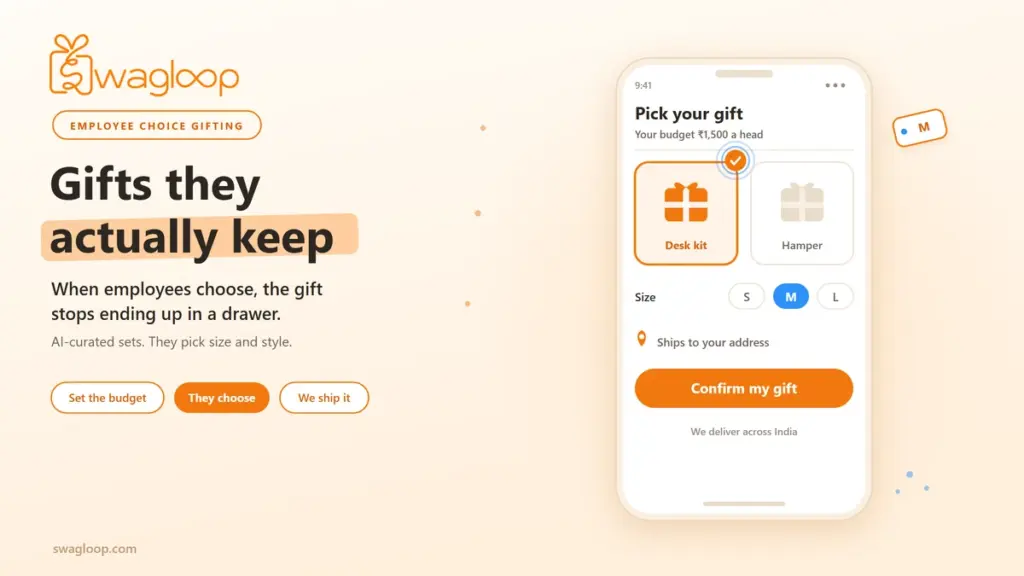
Employee choice gifting is a simple model. You set the occasion and a per-head budget, approve a small set of options, and each employee picks the one they want, along with the size or variant. They enter their own address, and the gift ships to them directly.
The options are not random. They come from a curated set built around your budget and occasion, the same idea behind AI-curated corporate gifting, where a brief and a budget turn into a short list of packs that fit.
Employees control three things.
- The gift: They choose from your approved set.
- The size and variant: T-shirt size, color, or style, picked by the person who will actually wear it.
- The address: Entered once by the recipient, so nobody chases it by hand.
The category can stay the same for everyone while the final pick belongs to each person. That single shift is what makes the gift feel personal at any headcount.
Why Letting People Choose Beats Guessing
Choice works because it turns a generic gesture into a personal one without you needing to know every person. When someone selects their own gift, it lands as recognition rather than routine.
That feeling is what you are paying for.
The data backs this up. McKinsey found that up to 55% of employee engagement comes from nonfinancial recognition, and that 67% of employees rank praise and meaningful acknowledgment above financial incentives. A gift only earns that response when it feels chosen for the person rather than issued to a list.
People expect this now. McKinsey’s work on personalization shows 71% of people expect personalized experiences and 76% feel frustrated when they do not get them. A default gift everyone receives sits on the wrong side of that line.
When every employee picks their own item from a set you approve, every gift feels personal, even when the budget and the shortlist stay the same across the whole company.
Does Choice Make Gifting Harder to Run?
The worry is fair. Letting hundreds of people choose sounds like it would create chaos, more emails, and a budget that drifts. In practice it does the opposite, because the choice happens inside guardrails you set once.
Several guardrails keep choice under control.
- Budget stays fixed: Every option in the set sits inside your per-head cap, so spend cannot drift.
- The set stays small: Employees pick from a short approved shortlist of curated gift packs built for the occasion, so nobody browses thousands of products.
- Addresses collect themselves: Each recipient fills in their own details through a link, which removes the spreadsheet chase.
- Sizes sort themselves: The person who wears it picks the size, so returns and reorders drop sharply.
Swag automation handles the parts that used to eat your week. Your team approves the set once and watches orders move, instead of coordinating each one by hand.
How to Roll Out Employee Choice Gifting at Scale
Running choice-based gifting across a whole company takes five steps. Each one replaces a manual job your team used to do, which is why the model holds up at 40 recipients or 4,000.
- Set the brief and budget. Pick the occasion, the headcount, and a per-head figure.
- Approve the curated set. Review a short list of packs that fit the budget and sign off.
- Share the pick-and-size link. Each employee selects their gift, variant, and size.
- Let addresses collect themselves. Recipients enter their own delivery details once.
- Track delivery in one place. Orders ship across India with tracking you can watch.
That is what employee gifting management looks like when the platform owns the flow end to end. If you are weighing this against a traditional vendor, it helps to know how the corporate gifting companies in India differ on exactly these steps, since most stop at selling you the gifts.
What Choice-Based Gifting Costs in India
Choice-based gifting costs the same per head as traditional gifting. You set the budget, and the options fit inside it. What changes is how far that budget goes, because money stops leaking into wrong sizes, returns, and gifts that never get used. A ₹1,200 gift someone picked themselves often does more for morale than a ₹2,000 gift that sits unopened, so the same invoice works harder.
The math here is simple.
What companies spend per head in India varies by occasion. These ranges reflect common industry norms rather than fixed prices.
| Gifting occasion | Typical per-head range | What usually fits the budget |
|---|---|---|
| Everyday recognition | ₹300 to ₹700 | A small curated pick or accessory |
| Festive and Diwali gifting | ₹700 to ₹1500 | Curated hamper, apparel, or drinkware |
| New-hire welcome kit | ₹1000 to ₹2500 | Branded kit with apparel and a tech accessory |
| Leadership and CXO gifts | ₹5000 and up | A premium single item |
Most platforms set a minimum order quantity, often around 40 units, so the model suits teams gifting at scale rather than one-off presents. Different corporate gifting platforms stretch the same budget differently, so the provider you pick changes what lands in the box.
When Choice Isn’t the Right Call
Choice-based gifting fits most team gifting, though not every situation. A few cases still call for a single, hand-picked gift, and it helps to know them before you set up a campaign.
- Very small teams: With only a handful of people, you likely know everyone well enough to pick well.
- A single high-touch gift: For one major client or a CXO, a chosen personal gift can carry more weight than a menu of options.
- Tight, fixed timelines: When a gift must arrive in a day or two, the pick-and-ship window may be too short.
For everything else, from festive runs to steady new-hire gifting, choice is the model that scales without losing the personal feel. A growing team that gifts every month gains the most, since the savings and the goodwill build up campaign after campaign.
Conclusion
The drawer full of unused gifts is a solved problem. When people pick what they want, your budget turns into something they keep, and your team stops chasing sizes and addresses through email. The only question left is how soon you want to stop guessing. See how Swagloop’s AI-curated gift packs let your team choose for themselves.
Frequently Asked Questions
How many gift options should employees get to choose from?
A short set works best, often three to six options. Too few feels like no real choice, while too many slows people down and makes approvals harder. The aim is a curated shortlist that fits your budget and the occasion.
Can remote and work-from-home employees use choice-based gifting?
Remote teams are where the model helps most. Each person enters their own address through a link, so gifts reach home offices across the country without anyone collecting details by hand or shipping in bulk to an office.
What happens if an employee doesn’t pick a gift in time?
Most platforms send reminders before the window closes. If someone still does not respond, you can set a default pack to ship automatically or extend the deadline, so no one gets left out of the campaign.
Do employees see the gift’s price when they choose?
Usually the price stays hidden. Employees see the options and pick freely while the budget works in the background. Keeping prices out of view holds the focus on the gift itself and avoids any awkward comparison between choices.
Is custom branding possible when employees pick their own items?
Branding still works across a choice-based set. Apparel, packaging, and signature items can carry your logo while the employee picks the style or size, so the gift feels personal and on-brand at the same time.