

You have 200 gifts to send for Diwali and one question with no clear answer. How much do you spend per person? Set it too low and the gift feels cheap. Go too high and finance asks why the line item doubled.
Most teams settle this with a guess. They copy last year’s figure or match what a competitor spent. Neither one tells you the right corporate gifting budget per employee in India for your own team.
Below, we give you a real way to set that number. We cover what companies spend today, how to build your own per-head figure, how to split it across the team, the tax rule that caps it, and where budgets quietly waste money.
What Do Indian Companies Actually Spend Per Employee?
Most Indian companies spend between ₹300 and ₹5,000 per employee on a single gift. The figure moves with the occasion and with who sits on the receiving end.
Everyday recognition sits at the low end. Festive gifting for the whole team lands in the middle. A leadership or top-client gift runs well above both. None of these are fixed prices. They are the ranges most teams work within, and they give you a sensible place to start before you set your own number.
The range is wide for a reason. A funded startup handing out welcome kits spends very differently from a manufacturer sending festive sweets across a large floor. Your industry, your headcount, and what you want the gift to say all pull the figure up or down.
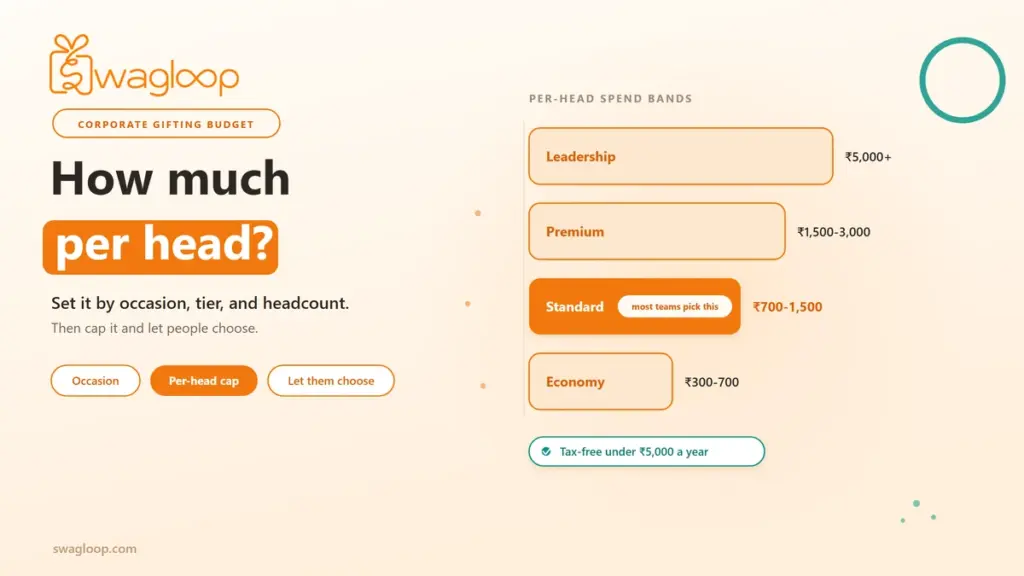
The bands below tend to hold across Indian companies.
| Spend band | Per-head range | Common use | What it signals |
|---|---|---|---|
| Economy | ₹300 to ₹700 | Large giveaways and event handouts | A small thank-you at scale |
| Standard | ₹700 to ₹1500 | Festive and Diwali gifting for the team | Real appreciation on a sane budget |
| Premium | ₹1500 to ₹3000 | New-hire welcome kits and milestones | A gift people notice and keep |
| Leadership | ₹5000 and up | CXO gifts and key client gifts | A high-touch personal gesture |
Where does your gift sit?
For most teams the honest answer is the standard band, because that is where festive and appreciation gifting lives. The real skill is knowing when to move up a band and when to hold steady. That is what the next section works out.
How to Set Your Corporate Gifting Budget Per Employee
Your corporate gifting budget per employee comes from three inputs rather than a single rule. Start with the occasion, adjust for who receives the gift, then test the total against your headcount.
In that order, the number almost sets itself.
Four steps take you from a blank figure to one you can defend.
- Start with the occasion: A festive gift, a welcome kit, and a work-anniversary token each sit at a different level. Name the occasion first, because it fixes your baseline range.
- Adjust for the tier: A gift for the whole team and a gift for a CXO should not carry the same figure. Move up a band for leadership, milestones, and the clients you most want to keep.
- Check it against headcount: Multiply the per-head figure by your people, then hold it against the total you have to spend. Watch the minimum order too, often around 40 units, since small runs cost more per piece.
- Cap the spend, then open the choice: Fix a per-head cap and let people pick inside it. The cap protects your budget while employee choice gifting makes sure the money lands on something the person actually wants.
In practice, that looks simple. A 120-person team planning Diwali corporate gifts starts in the standard band, sets a ₹1,200 per-head cap, checks that 120 units clears the 40-unit minimum, and lets each person choose within the cap. The budget is locked before anyone picks a product.
Notice what this does. You stop asking what to buy and start asking what the occasion is worth per person. That one shift turns the budget into a decision instead of a guess.
Should You Budget by Occasion or by Seniority?
Use both.
Set a base per-head figure by occasion, then lift it for leadership, long-service milestones, and key clients. A single flat number for everyone either overspends on the majority or underwhelms the few people you most want to keep.
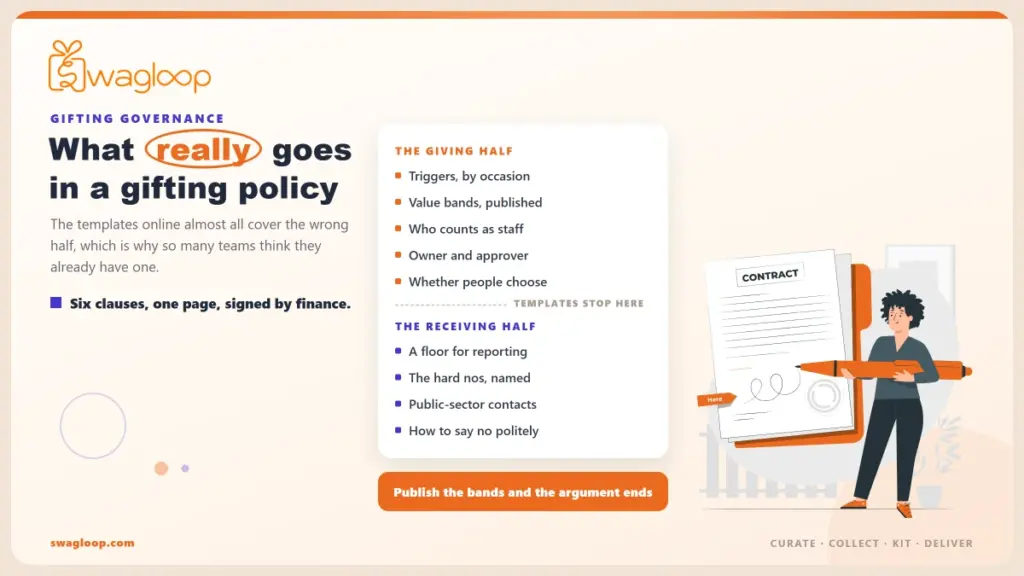
Most teams work from an annual pot and split it across the year. The simplest way to divide it is by recipient group.
| Recipient group | Per-head level | Why it works |
|---|---|---|
| Whole team, festive | Standard band | Everyone is included and the cost stays predictable |
| New hires | Premium band | The first gift sets the tone for the whole tenure |
| Managers and long service | Premium to leadership | Recognition scales with contribution |
| Leadership and top clients | Leadership band | A personal gift carries more weight at the top |
The balance counts for more than any single figure. A team that spends steadily on onboarding kits through the year often gets more back than one that blows the whole budget on a single Diwali run.
Steady beats splashy when you are building how people feel about the place.
The Tax Rule That Should Shape Your Gift Budget
One line in India’s income tax rules gives you a natural ceiling. From 1 April 2026, gifts, vouchers and tokens from an employer are tax-free up to ₹15,000 a year in total. The limit was ₹5,000 until 31 March 2026. Go over, and the whole value can become taxable in the employee’s hands.
That single figure is a useful anchor for team gifting. A few points decide whether a gift stays inside it.
- Non-cash gifts count here: Hampers, apparel, branded kits, and vouchers for goods all sit under the limit.
- Cash is treated differently: Cash, or anything easily turned into cash, is taxed as salary whatever the amount.
- The limit is annual and per person: The ₹15,000 covers every gift to one employee across the whole year, added together.
Keeping each person’s yearly total under ₹15,000 keeps most gifting simple and tax-free. That is one more reason the premium band works so well for the gifts you want to feel special.
Where Gifting Budgets Quietly Leak
The budget is rarely the real problem. Most gifting money leaks after the spend gets approved, through waste that never shows up as a line on the finance sheet. Wrong sizes come back, gifts sit unused in a drawer, and someone loses two days chasing delivery addresses.
The invoice looks fine while the value quietly drains away.
These are the leaks that cost the most.
- Wrong sizes and returns: Apparel in one size suits a fraction of the team, and every reorder costs you twice.
- Gifts nobody uses: A single item picked for an average person pleases almost no one on the real list.
- Address chasing: Collecting delivery details by hand over email and chat burns hours of your team’s week.
- Over-ordering: Buying well above headcount leaves extra stock you cannot store or reuse later.
- Rush shipping: Late planning turns into premium delivery charges that eat into the gift budget.
The fix is to spend on fit rather than on the size of the spend. People expect personalized experiences everywhere else, and gifting is the same. A ₹1,200 gift someone chose themselves often beats a ₹2,000 gift that lands wrong, which is the whole idea behind AI-curated corporate gifting built around a set budget.
How to Stretch the Same Budget Further
The same per-head spend can buy a clearly better gift. It comes down to cutting the waste above and letting the model carry more of the load.
Three moves make the biggest difference.
- Let people choose: Recipient choice removes wrong sizes and unwanted gifts in a single step.
- Buy through a managed marketplace: One network strips out the markup and manual labour that vendors usually pass on to you.
- Automate the flow: Swag automation handles address collection, production, and PAN India delivery without your team coordinating every order by hand.
- Brand it with care: Custom branding on apparel and packaging lifts how the gift feels without adding much to the cost.
There is a payoff beyond the budget. Only 31% of employees feel engaged at work, and a gift someone actually uses is a small, real way to close part of that gap. When your gifting runs through one corporate gifting platform in India that handles choice, curated gift packs, custom branding, and delivery together, employee gifting management stops eating your week and the same budget works harder.
Spend the same money with less waste and better fit, and a modest per-head figure starts to feel generous.
Conclusion
The right number is the one you can stand behind. Set it from the occasion and the person, cap the per-head spend, keep it inside the tax-free line, and put the money where it lands instead of where it leaks. Do that, and a modest budget starts to look generous.
Ready to see what your budget can actually buy? See how Swagloop’s AI-curated gift packs turn a per-head figure into gifts your team picks and keeps.
Frequently Asked Questions
Is there a minimum order size for bulk corporate gifting?
Most platforms set a minimum, often around 40 units. That keeps the model suited to team gifting rather than one-off presents. Below the minimum, per-unit costs climb, because branding and setup get spread across fewer pieces.
How far ahead should you plan a festive gifting budget?
Give yourself 12–14 working days plus about two weeks before the occasion. Delivery across India takes 12–14 working days, and approvals, branding, and employee choice all need time on top of that. Planning early also keeps you clear of rush shipping charges.
Should a startup use the same per-head budget as a large enterprise?
Company size shapes the figure more than any rule does. A funded startup often spends ₹1,500 to ₹3,000 per head to make a strong first impression, while a large enterprise may set a lower per-head figure and lean on scale instead.
What happens to leftover gifting budget at year-end?
Order close to your real headcount and little gets left over. Platforms that hold no stock between campaigns mean you never pay to warehouse extras. Any surplus is better rolled into the next occasion than spent on filler nobody asked for.
How do you track what a gifting campaign actually cost?
A dashboard that shows orders, spend, and delivery in one view gives you the real figure, including the true per-head cost after everyone chooses. Manual tracking spread across emails and invoices tends to miss the small overruns that add up.