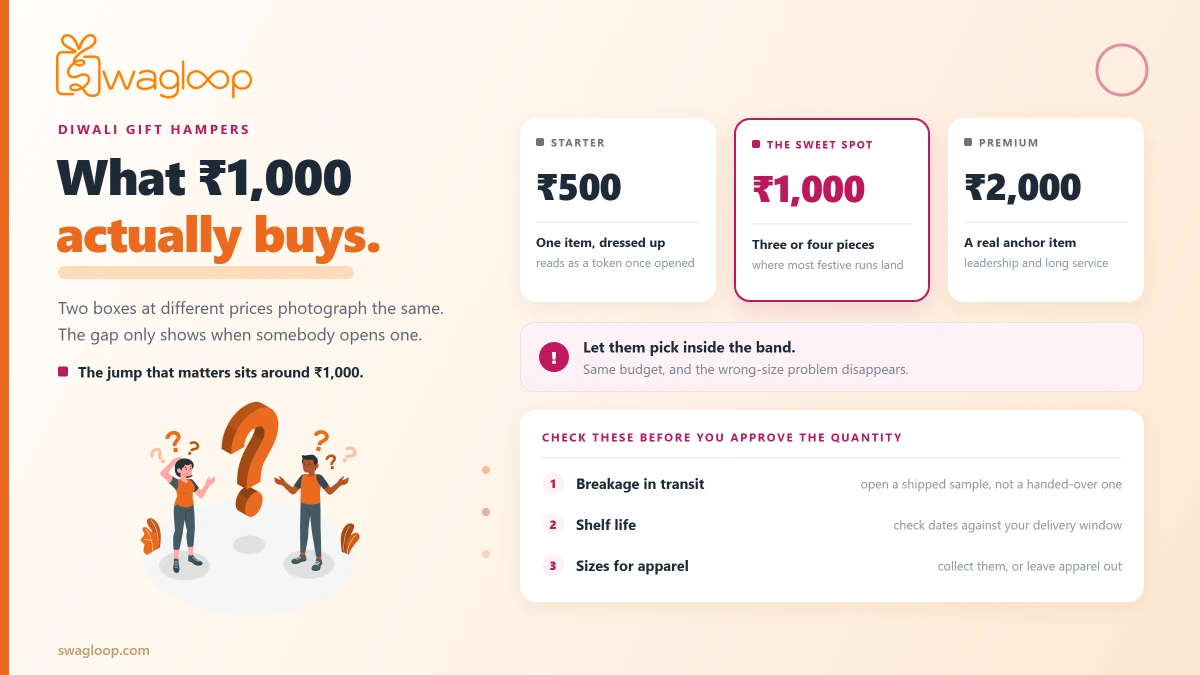
Corporate Diwali gift hampers all look the same in a catalogue. A box at ₹800 and one at ₹1,600 photograph beautifully from the same angle, and the difference only shows when somebody opens one at their desk.
That gap is where most festive budgets get spent badly. You approve a number, the vendor fills it with whatever hits that number, and a good share of the order quietly moves on to a relative.
Diwali 2026 falls on Sunday 8 November, which puts the ordering window right about now. So it is worth knowing what each price point actually holds before you sign off on a quantity.
Let’s start with what changes as the number goes up.
What Goes Into a Diwali Hamper at Each Budget Band
Under ₹500 you are buying one decent item with festive packaging around it. Between ₹700 and ₹1,500 an actual hamper appears, with three or four things that work together. Above ₹2,000 you are paying for the anchor item, the box, and a finish that survives being handed over in person.
The jump that matters most sits around ₹1,000.
Below it, you are choosing one thing and dressing it up. Above it, you build a small collection where each piece has a job.
| Per-head band | What actually fits | What to watch |
|---|---|---|
| Under Rs 500 | One useful item plus festive packaging | Reads as a token the moment the box opens |
| Rs 700 to Rs 1500 | Three or four items chosen to work together | The band most festive employee runs sit in |
| Rs 1500 to Rs 3000 | A premium anchor item with supporting pieces | Needs a clear reason, or it looks arbitrary |
| Rs 3000 and up | A standout piece with gift-grade finish | Best kept for leadership and long service |
Those bands move with city, headcount, and how often you gift, which is the whole reason to fix a per-head gifting budget before you look at a single product.
One number sets a hard ceiling on all of this. Employee gifts stay tax free up to ₹5,000 per person in a financial year, and crossing it makes the full value taxable rather than only the excess. That limit counts every gift across the year, so a generous Diwali pack can push someone over on its own. The mechanics sit in the detail on tax on employee gifts.
Pick the band first, then fill it. Working the other way around is how a ₹900 budget ends up buying ₹900 of unrelated items in a box.
Why Dry Fruit Hampers Dominate, and When They Backfire
Dry fruit wins on Diwali because it offends nobody. Almonds, cashews, and dates read as premium across regions, ages, and dietary rules, they need no sizing, and they survive a courier van in October. For a company gifting to a few hundred mixed people at once, that is a very short list of problems.
We get asked for dry fruit more than any other festive pack, and it is also the gift most likely to arrive at someone’s home four times in the same fortnight.
The trouble is that every other company worked this out too.
Where the safe pick stops being safe
Someone at a mid-size firm can receive four dry fruit boxes in one fortnight. The fourth does not feel like recognition. It feels like inventory, and it goes to whoever visits next.
- Nobody eats four kilos of cashews: Volume turns a nice gift into a redistribution problem for the recipient.
- The jars all look alike: Without branding or a distinct pack, your box matches the other three on the counter.
- Quality is hard to see through packaging: Two hampers at the same price can hold very different grades of nut, and the buyer finds out after the run ships.
- It ages badly in a warm October: Loose seals and long transit turn a premium item stale.
There is real money sitting in that pile. The economist Joel Waldfogel measured what recipients would have paid for their gifts against what givers actually spent, and found gifts from distant givers lose up to a third of their value. An employer is a distant giver.
None of that makes dry fruit a bad choice. It makes dry fruit a choice that needs one differentiator to survive the pile.
So what rescues it? Usually a single added item rather than a whole redesign. Add one thing the recipient keeps after the food is gone, and your box stops being interchangeable. A good travel mug, a brass diya set, or a well-made notebook does more for recall than upgrading the nuts.
Keep the food if it fits your team, and give the box one thing that outlives it. Recall comes from the item still sitting on a desk in March.
Should Every Employee Get the Same Hamper?
A flat hamper across the whole company is the cleanest option, and for most Indian teams under 300 people it is also the right one. Everybody gets the same box, nobody compares, and your admin load stays at one pack to approve. Tiering earns its complexity only when the gap between grades is large enough that a single gift cannot serve both ends.
So which approach fits your team? Tier when you can defend the reason out loud.
| Approach | Works when | Costs you |
|---|---|---|
| One pack for everyone | Team under ~300, similar roles and pay bands | A Rs 1000 gift underwhelms senior staff |
| Two tiers by seniority | Clear leadership layer, visible pay gap | Somebody will find out and do the maths |
| Tiers by years of service | Long-tenure staff you want to mark | Newer joiners need a reason it feels fair |
| Same pack, choice inside it | Mixed team, wide range of tastes | Needs a platform to run the selection |
The last row is the one most teams never consider, and it solves the problem the other three create.
Recognition is the actual point of the exercise. A hamper on its own does not fix how people feel about their week. A hamper that clearly took thought, arriving at the right person with their name spelled correctly, is a small honest signal in the right direction.
If you do tier, keep the gap explainable
Two tiers is manageable. Four becomes a ranking system that your team will reverse-engineer in a group chat within a day of delivery. Keep the top band for a small group, and make the difference about the anchor item rather than the count of things in the box, since a fuller box reads as more expensive even when it costs the same.
A flat pack with real choice inside beats a tier chart almost every time. It removes the comparison without removing the personalisation.
Where Diwali Hampers Go Wrong
Festive orders rarely fail on the gift itself. They fail on five things nobody checks until the boxes are moving, and each is visible weeks earlier if you ask at sample stage.
Run through these before you approve the quantity.
- Breakage in transit: Glass jars, ceramic diyas, and loose bottles crack in bulk shipping. Ask what the inner packaging holds each item with, and open a shipped sample rather than a handed-over one.
- Shelf life shorter than your timeline: Sweets and fresh food can expire between production and doorstep. Confirm manufacture and expiry dates against your real delivery window rather than the order date.
- Branding that ruins a good item: A heavy logo across the front of a mug turns a gift into merchandise. Placement decides whether people use it, which is why custom branded gifts are a design question.
- One size for a whole company: Apparel in a hamper without a size step guarantees a share of the order fits nobody. Either drop apparel or collect sizes.
- The outer box nobody looked at: Your hamper arrives inside a scuffed brown carton with tape across the lid. People see that first.
We see point three catch good teams repeatedly. A logo belongs somewhere a person would accept on something they bought themselves, which usually means small, tonal, and off-centre.
Every one of these is cheap to catch at sample stage and expensive after dispatch. Order one sample shipped to a real address before you sign off.
Can Employees Pick Their Own Diwali Hamper?
Employees can pick their own, and the mechanics are simpler than most HR teams expect. You approve a short set of packs at one budget, share a link, and each person picks the one they want along with any size. You keep control of spend and quality. They get a gift they chose.
The waste problem largely disappears at that point.
Guessing on behalf of four hundred people is a statistical certainty of getting a chunk of it wrong. So what does letting go actually cost you in control? Nothing at all, because every option on that list was signed off by you before the link went out.
- You set the ceiling: Every pack sits at the same per-head number, so the spend cannot drift.
- They choose the fit: Tastes, dietary rules, and sizes get handled by the person who knows them.
- Addresses arrive with the choice: The same form collects where the box goes.
- Nothing gets chased: No spreadsheet, no reminders, no last forty replies.
That model is letting employees choose, and it suits festive runs better than any other occasion, since Diwali is the one date you gift the whole company at once.
The research explains why guessing feels safer than it is. In a Journal of Experimental Social Psychology study, recipients appreciated gifts they had asked for more than surprises, while givers assumed both landed equally well. That gap is where most festive budgets quietly go.
Building the set used to be the slow part. Describing the occasion and budget and getting a small set of AI-curated packs back beats browsing a catalogue of thousands.
Choice inside a fixed budget gives you the control of a bulk order and the feel of a personal one. Both, from the same purchase order.
Running the Order Without Chasing Anyone
A festive run comes apart on addresses and sizes rather than on the gift. Fix those two inputs with a single self-serve link and the rest of a bulk Diwali gifting campaign becomes scheduling. Everything after collection runs on clean data.
We run these campaigns end to end, and six steps cover a full one.
- Set the brief and the per-head number: Occasion, headcount, and budget, before any product enters the conversation.
- Approve a small set of packs: Three or four options at the same band, each one you would be happy to send.
- Share one link with the team: Each person picks their pack and size, and enters their own current address.
- Close the window: Set a date, then dispatch on whatever is in hand rather than waiting on stragglers.
- Brand and assemble: Logo placement, kitting, and packing happen once the real numbers are in.
- Track to the doorstep: Every parcel carries tracking, so you know what landed and what did not.
Two operational limits are worth planning around. Orders start near 40 units, and delivery runs 7 to 10 days across India with a GST invoice on every order. A run booked with a few weeks in hand clears production and leaves room for a second attempt.
Where do your people actually sit? A single office drop is one logistics problem, and remote employee gifting across twenty cities is another, mostly because home addresses live nowhere in your HR system until somebody asks. At larger headcounts that same collection step holds the run together, covered in more depth for gifting for 500+ employees.
Delhi NCR runs carry their own quirks around office density and last-mile timing, covered in Diwali gifts across Delhi NCR.
Collection is the bottleneck on every festive order. Solve it with a link and the calendar stops being frightening.
Conclusion
The hamper you pick matters less than the three decisions around it. Set the band before you shop, give the box one item that outlives the food, and let people choose their own pack and size inside the budget you approved. Do that and a company-wide Diwali run stops being a month of chasing and starts being one date in the calendar.
Want your Diwali gifting campaign to run on a brief instead of a spreadsheet this year? See how SwagLoop works and set your budget in a few minutes.
Frequently Asked Questions
What should the card inside a Diwali hamper say?
Keep it short and specific to the team. A line about the year the group has actually had beats a printed festive greeting, which reads like it arrived with the box. Sign it from a real person rather than from the company name. Two lines is plenty.
Do corporate Diwali hampers need to be vegetarian?
Most Indian companies default to vegetarian for a company-wide festive run, since a mixed team makes any other choice a guess. Watch for eggs in baked items and gelatin in sweets. Confirm ingredients with your vendor rather than reading the product photo.
How many hampers should you order above headcount?
Five to ten percent over your final headcount covers damaged units and people nobody counted. Gifts get assembled per campaign with no stock held between runs, so any extras stay with you.
What happens if an employee is on leave when the hampers arrive?
Home delivery avoids most of this, because the box waits at their door instead of an empty desk. For office drops, leave the spares with your admin team and hand them over on return. Tracking shows you which parcels went undelivered and why.
Do you send a Diwali hamper to someone who joined last week?
A week-old joiner belongs on the festive list, and being left off gets remembered far longer than the gift does. Their address already sits in your onboarding form, so adding one more box costs you the unit price.