

Your distributor network moved a lot of product this year. Someone in sales has asked for a gifting budget, finance has asked what it costs, and nobody has asked what the company owes when a box worth ₹8,000 lands at a dealer’s office.
Channel partner gifting looks like employee gifting from the outside. The budget line reads the same, the vendor is often the same, and the boxes look alike.
The rules underneath are not the same at all.
Your dealers are separate businesses. That single fact changes the tax treatment, the spend logic, and who should be picking the gift. Let’s take those in order.
How is channel partner gifting different from employee gifting?
An employee gift goes to someone on your payroll, so it counts as part of what you pay them. A partner gift goes to another business, so it counts as a benefit passing between two firms. Different part of the law, different paperwork, different budget logic.
| Question | Employee gift | Channel partner gift |
|---|---|---|
| Who receives it | Someone on your payroll | A separate business |
| The rule that bites | Perquisite value added to their pay | TDS on benefits given in business |
| Who picks the gift | More and more, the recipient | Usually the brand, which is the problem |
| GST input credit | Blocked on gifts | Blocked on gifts |
| What sets the budget | Headcount and a per-head band | Partner tier and sales contribution |
Two of those rows catch people out.
The gift your dealer receives is income to their business. So the obligation to deduct tax sits with you, the giver, rather than with them.
And the budget cannot be a flat per-head number. A retailer who sold forty units and a distributor who sold four thousand are not the same recipient, which is a departure from how client gifts usually get planned.
The tax rule most dealer gifting budgets miss
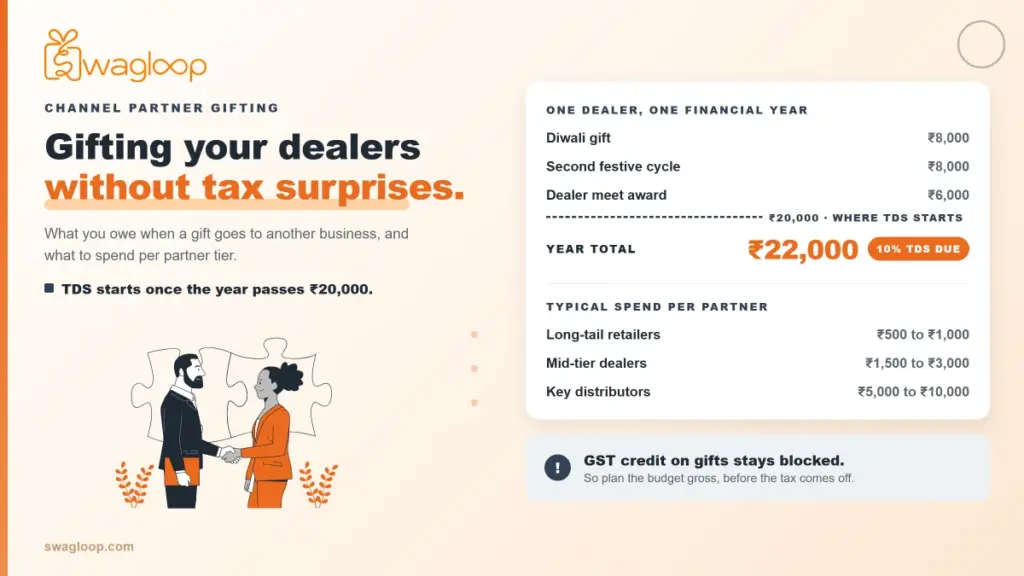
Since July 2022, a business that gives a benefit to a resident has to deduct tax before handing it over. The rule was Section 194R of the Income-tax Act, 1961, and from 1 April 2026 it sits in Section 393 of the Income-tax Act, 2025. The rate is 10 percent, and it starts once the total value to one recipient crosses ₹20,000 in a financial year.
Read that threshold carefully. It counts the year, rather than the gift.
- A single ₹8,000 Diwali box: Under the line, nothing to deduct.
- The same box twice, plus a ₹6,000 dealer-meet award: ₹22,000 in the year, so the whole amount comes into scope.
- A foreign trip or an event invite: Counts as a benefit just as a physical gift does.
- Free samples given beyond normal trade practice: Also a benefit.
Does your biggest dealer clear that line? Most of them do.
The TDS on business benefits applies whether or not the dealer treats the item as taxable. That catches out finance teams who assume the dealer sorts it out.
There is a second cost sitting beside it. Under the CGST Act you cannot claim input tax credit on goods “disposed of by way of gift or free samples”, which is set out in Section 17(5) of the Act.
So the GST you pay on a gift is a real cost rather than a recoverable one.
Plan the budget gross. A ₹10,00,000 channel gifting spend does not buy ₹10,00,000 of gifts once blocked credit and any TDS are counted, and the gap is wide enough to matter at scale. The employee side has its own version of this, which the tax on employee gifts works through separately.
Why one gift for the whole network backfires
Most brands order one pack and send it to everybody, because one pack is easy to approve. It is also where the money goes.
How many of your partners could you name?
You have almost certainly never met most of the people receiving these boxes. Work on gift value has found that gifts chosen by people far from the recipient lose a large part of their worth, a result set out in Waldfogel’s study of holiday gifts. A sales head picking one item for four hundred shops across nine states is about as far off as a giver gets.
- The apparel problem: One size range across a national network guarantees waste.
- The regional problem: Food and drink items that work in one state offend in another.
- The status problem: Your biggest distributor gets the same box as your smallest, and notices.
- The storage problem: Partners run shops, and they have nowhere to put a bulky item.
The fix is the same one that works internally. Approve a set at a price band, then let the partner pick inside it, which is why letting people choose has moved from a nice idea to the default for gifting at scale.
Choice also solves your size and address problem in the same step, since the partner enters both when they pick.
How much should you spend per channel partner?
Spend by tier, weighted to sales contribution. What follows is what we see across campaigns rather than a published benchmark, so treat it as a starting shape and set your own bands against your margins.
| Partner tier | What we typically see per partner | What fits the band | Watch for |
|---|---|---|---|
| Long-tail retailers | INR 500 to 1,000 | Branded daily-use items, small packs | Volume is high, so per-unit cost decides the total |
| Mid-tier dealers | INR 1,500 to 3,000 | Curated packs, apparel with size choice | Sizes need collecting rather than guessing |
| Key distributors | INR 5,000 to 10,000 | Premium single items, personalised packaging | Two cycles a year clears INR 20,000 |
| Award winners at a dealer meet | INR 10,000 and above | Recognition pieces, higher-value electronics | The year's total counts, including earlier gifts |
Run the annual total per partner before you approve the cycle. A brand gifting twice a year plus recognising top performers will push its best partners over the threshold every time, and that is a planning question rather than a surprise.
Set the bands, then hold them.
The per-partner logic is close to how a per-head budget gets set for staff, with sales contribution replacing headcount as the weighting.
What to send at a dealer meet and what to send at Diwali
The two occasions pull in opposite directions, and using one gift for both is the most common mistake we see.
A dealer meet is public. People collect the item in a room full of peers, so it works as recognition and it gets compared out loud.
Diwali is private and lands at the shop or the home.
- At a dealer meet: Send recognition items, and vary them by award tier so the difference is visible.
- At a dealer meet: Skip anything bulky, because partners are travelling home with it.
- At Diwali: Send something the household will open, since the gift arrives where the family is.
- At Diwali: Time the order early, because the festive window compresses everyone’s production at once.
- Either occasion: Keep custom branding restrained, since a partner will not use an item that reads as a billboard.
Diwali 2026 falls in early November. Work back from that. A 7 to 10 day delivery window across India, plus branding and sign-off, puts the order date in September rather than late October.
How do you run a channel gifting campaign without the chase
The day to day load is why these campaigns slip, and almost all of it is chasing addresses and sizes. Partners are harder to chase than staff, because they do not report to you.
So who owns the partner list?
- Split the network first. Pull the partner list by tier and sales before you look at any product.
- Set a band per tier, then check each tier’s annual total against the ₹20,000 line.
- Approve a small set per band rather than one item, so partners have a real choice inside your budget.
- Send one link. Partners pick their item, choose a size where it applies, and enter their own delivery address.
- Order close to the confirmed count. We hold no stock between campaigns, so extras stay with you.
- Track to delivery, and keep the deduction record alongside the order for anything over the threshold.
Two constraints worth knowing before you plan. Orders start at 40 units per SKU, and delivery runs across India only, so an overseas partner needs a different route.
Get that split right and the rest is mostly waiting.
Where to start on this year’s cycle
Channel gifting works when the gift matches what the partner actually contributed and the paperwork was planned rather than discovered. Both of those get decided before a single product is chosen.
The brands that run this well spend their time on the partner list. The ones that struggle spend it chasing addresses in November.
Want the tier bands and the choice sets built for your network before the festive window closes? Start with Swagloop and we will take it from the partner list.
Frequently Asked Questions
Who pays the TDS when the gift routes through a distributor’s own team?
The duty stays with the business giving the benefit. Passing a gift through a middleman does not move it, so keep the tax record against the partner who ends up with the item rather than the one who handed it on.
Can a channel gift be booked as a business promotion expense?
Booking it as promotion is normal for the cost itself. The blocked GST credit and any tax cut sit apart from how the cost gets booked, so treat them as two questions rather than one.
Does a gift card avoid the compliance question?
Vouchers count as a benefit the same way goods do. Swapping a box for a card changes the delivery and the feel of it, and the yearly limit stays put.
What happens when a partner refuses the gift?
Refusals happen most often where the partner’s own policy caps what staff may accept. Note it, drop that partner from the cycle, and move the budget rather than sending a smaller box.
Should the sales representative hand it over in person?
Hand delivery builds the bond and slows the campaign down. A useful split is in person for your top tier and direct dispatch for the rest, so your team travels where it counts.