

Distribution day at a plant near Faridabad. The office team collects wrapped hampers from a table in reception. Out on the shop floor, a supervisor hands over a smaller box from a stack near the gate.
Nobody announced a difference. Everybody saw one.
Diwali gifts for workers go wrong in that gap, and the money is almost never the reason. A company can spend well and still land badly, because people read a gift against what the person next to them got.
So the first question worth asking is not what to buy. It’s who is on the list, and what each group will compare their box to.
Why Do Diwali Gifts for Workers Go Wrong?
A gift gets judged by comparison rather than by cost. Give the office a ₹1,500 hamper and the shop floor a ₹400 box of the same brand, in the same wrapping, and you have not given two gifts. You have published a ranking.
The pattern shows up clearly in research on pay.
Card, Mas, Moretti and Saez studied what happened when University of California staff were told about a website listing colleagues’ salaries. Their finding is blunt. Staff paid below the median reported lower satisfaction and were significantly more likely to start job hunting, while people above the median were unaffected.
The line that matters for a gifting budget is the last one in their abstract.
Differences in pay rank matter more than differences in pay levels.
Swap “pay” for “gift” and you have the whole problem in a sentence.
What People Compare, and What They Ignore
Nobody on your shop floor is auditing invoice values. They are looking at three things.
- Shape and wrapping: Two boxes from the same range, in different sizes, invite the comparison instantly.
- Where it was handed over: A table in reception reads differently from a stack by the gate.
- Who handed it to them: A supervisor passing out boxes is not the same gesture as a manager doing it by name.
The Cheaper-Version Trap
Most companies land here by accident. They pick a good hamper for the office, then ask the vendor for the same thing at a third of the price for everyone else.
The result looks exactly like what it is. A budget gift wearing the same clothes as a better one.
Break the comparison instead. Give the groups different kinds of gift, so there is no single ladder to stand them on.
Who Is Actually on Your Diwali List?
Most manufacturing and services companies in India are gifting three different populations under one budget line, and treating them as one list is where the trouble starts. The useful split is by who employs someone and where they will open the box.
The group is growing, too. EPFO added 21.04 lakh net members in July 2025, and the Ministry of Labour and Employment listed garments making, beedi making and hospitals among the industries with the strongest month-on-month growth in net payroll, which is to say the formal workforce is expanding fastest in exactly the kinds of establishments where most people work a shift rather than a desk.
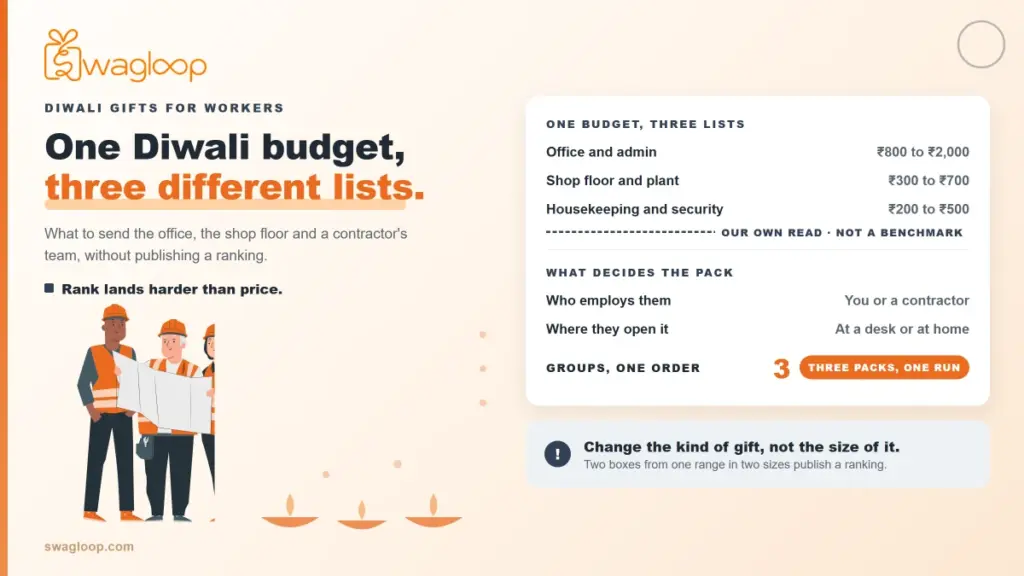
| Group | Who employs them | Where they open it | What fits | Typical band |
|---|---|---|---|---|
| Office and admin staff | You | At their desk, often same day | Curated hamper, choice of items | ₹800 to ₹2,000 |
| Shop floor and plant staff | You | At home, with family | Food, household and utility items | ₹300 to ₹700 |
| Housekeeping, security, canteen | A contractor | At home | Practical staples, routed via the contractor | ₹200 to ₹500 |
Those bands are what we see working across Indian sites. They are our own read rather than a published benchmark, and your per-head gifting budget should override them.
Notice that the bands still differ. The point is not to flatten spend. The point is that a food and household pack and a curated desk hamper are not on the same scale, so neither group is reading a rank off the other.
The Group Most Companies Forget
Contract staff get left off the list until the week before, then get added in a panic with whatever is left over. Leftovers are the worst possible signal, and the people receiving them are usually the ones on site the longest hours.
Decide about them in the same meeting as everyone else.
What Works at ₹200 to ₹500?
The low band is where most of this volume sits, and almost nothing written for it is useful. The rule that holds up is simple. At this price, buy something the household will finish or use, and skip anything decorative.
- Dry fruits and festive food: The default for good reason. It gets shared at home, it suits the occasion, and nobody has to find a place for it.
- Kitchen and household staples: Good quality ghee, a steel casserole, a pressure-cooker-sized item. Useful for months, and it reads as thought rather than surplus.
- Blankets and winter items: Diwali sits just ahead of north Indian winter, so the timing works.
- Utility kits: A solid thermos or a torch gets used on site and at home. Practical without being patronising.
- Sweets from a name people know: A recognised local brand carries more weight than an unbranded box twice the size.
What consistently misses at this band is anything logo-heavy, anything desk-shaped, and anything that needs a shelf. A branded mug is an office object. It has no job in most homes.
Why Food Does the Heavy Lifting
Food solves the sizing problem, the taste problem and the storage problem at once. It also travels well as a gesture, because it gets shared rather than owned.
Keep it vegetarian by default unless you know the site well, and check shelf life against your actual distribution date rather than your order date.
How Do You Handle Contract Staff?
Housekeeping, security and canteen teams usually sit on a contractor’s payroll rather than yours. Gifting them directly cuts across that relationship, and it can muddle who is responsible for what.
The clean route is to gift through the contractor.
- Agree it in advance: Tell the contractor what you are providing and for how many people, in writing, before the festival week.
- Hand it over on site: Let their supervisor distribute, so the reporting line stays intact.
- Budget it as yours: Fund it from your gifting line rather than expecting the contractor to absorb it.
- Count heads properly: Ask for the current deployed count, since contract rosters move more than your payroll does.
Keep the Gift Clear of the Bonus Conversation
Many people on the shop floor also receive a statutory bonus around this time of year. That money is a legal entitlement. It gets calculated, owed and paid on its own terms, and none of that has anything to do with what you choose to put in a gift box.
A gift can never stand in for it. Hand the two over separately, and let the gift be the part that carries no obligation at all.
How Do You Hand Out Gifts Across a Plant?
Distribution decides how the gift lands, and it is the part most plans skip. A good gift handed over badly still reads as an afterthought.
| Group | Route | Who hands it over | What goes wrong |
|---|---|---|---|
| Office staff | Desk drop or a short gathering | Reporting manager | Absentees get theirs weeks late |
| Shop floor | Shift-wise at a fixed point | Supervisor, by name from a list | Night shift misses out entirely |
| Contract staff | Through the contractor on site | Their supervisor | Counts drift, some people get missed |
| Remote or field staff | Home delivery | Courier, tracked | Nobody collected an address |
Run it shift by shift rather than in one go. A plant running three shifts needs three handovers, and the night shift is the one that gets forgotten nineteen times out of twenty.
Sizes, Languages and the Small Details
If anything in the pack is wearable, you need sizes, and collecting them from a shop floor is slower than collecting them from an office inbox. Build in an extra week.
Print any card or note in the language people actually speak on that floor. An English-only greeting on a Hindi-speaking site is a small thing that gets read as a large one.
How Do You Order for Three Groups at Once?
Three different packs sounds like three times the work. It is one order with three lines, provided you decide the split before you talk to anyone about products.
The sequence below is the one that keeps the split honest.
- Count each group separately: Your payroll gives you two numbers. The contractor gives you the third, and it will be the least accurate, so confirm it twice.
- Fix the split, then the products: Decide what each group receives and roughly what it costs before browsing anything. Reverse that order and the office pack quietly eats the budget.
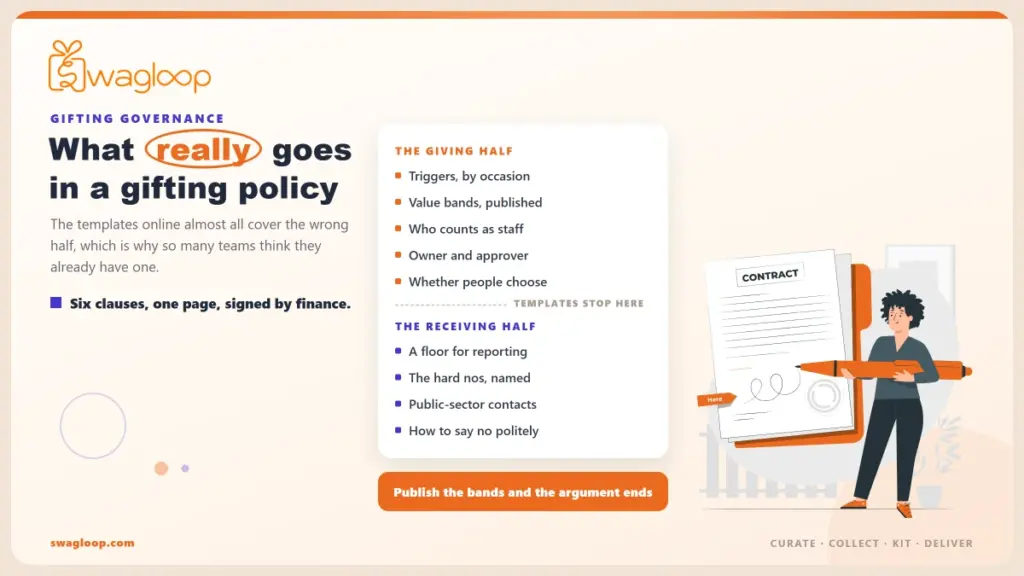
- Order as one run: One purchase order, one invoice, one delivery window. Our minimum is 40 units per SKU, so check that each group’s pack clears it.
- Collect addresses only where you need them: On-site groups get theirs at the gate. Home delivery is for remote and field staff alone, so you are not chasing hundreds of addresses you will never use.
Companies already handling gifting for 500+ employees run their festive campaigns this way. If your sites sit across the manufacturing belt, the practicalities of working with corporate gifting companies in Faridabad and the neighbouring hubs are worth reading alongside this.
One Order, Three Packs
Ask for the three packs to arrive labelled and boxed by group rather than mixed together on one pallet. Sorting them by hand on distribution morning, in a corner of the stores area, with a shift already waiting at the gate, is precisely how the night shift ends up missed and how somebody’s supervisor ends up apologising for a decision they had no part in.
Timing sits outside this piece, and our note on Diwali gifts across Delhi NCR covers the ordering calendar. For the office group specifically, the Diwali hamper bands go deeper on what each price point actually buys.
The Gift People Talk About at Home
Come back to that table in reception and the stack by the gate. The company had spent real money on both. It simply let one group watch the other get a better version of the same idea.
Change the kind of gift and the comparison disappears. A household pack that gets used for a month is not a lesser hamper, it is a different gift, and it does a job the hamper cannot do.
That is worth more than the fifty rupees a head you would save by shrinking the box.
Running one Diwali campaign across an office, a shop floor and a contractor’s team, and want the three packs handled as a single order? See what we put together, and tell us what your site count looks like.
Frequently Asked Questions
Should temporary and seasonal hires get a Diwali gift?
Anyone on site during the festival week should get something. Drawing the line at permanent staff creates a visible split on the floor at exactly the wrong moment, and temporary hires notice it first. Base the rule on presence and write it down.
What do you do about employees who don’t celebrate Diwali?
Frame it as a year-end company gift rather than a religious one, and choose contents that carry no ritual meaning. Food and household items work for everyone. The wrapping and the note do most of the framing work, so keep both neutral and seasonal.
Can you give cash instead of a gift on the shop floor?
Cash is treated as pay the moment it changes hands, which pulls it into payroll and tax rather than gifting. It also disappears into the month’s expenses without registering as anything. Vouchers sit somewhere in between and carry their own treatment.
What buffer should a plant allow above headcount?
Roughly five percent covers most sites. Contract rosters move, people transfer in from other units, and someone going home empty-handed on distribution day is remembered far longer than a few spares sitting in the stores cupboard afterwards.
Who should sign off on the worker gifting budget?
Plant HR and the site head together, with finance seeing the split rather than only the total. Approving one lump figure is how the office pack quietly grows and the shop-floor pack shrinks between the meeting and the purchase order.