

The resignation landed three weeks ago. Someone remembers the gift on a Tuesday, about forty minutes before the team gathers near the pantry. A junior colleague gets sent to the mall with a loose budget and no brief.
You know what comes back. A photo frame. Maybe a pen set in a velvet box nobody opens twice.
Farewell gifts for employees fail in a specific way. The objects are fine. The timing is the problem, and a longer shopping list won’t fix a decision made in the last hour.
So it’s worth asking who’s really watching when somebody leaves your company. It isn’t only the person walking out.
What Is a Farewell Gift Actually For?
A farewell gift tells your remaining team how the company treats people on the way out. The leaver gets an object. Everyone still on payroll gets a preview of their own last day, and they read it closely.
Most gifting advice sells a different reason. Keep the door warm, the argument goes, because leavers come back.
It’s a nice idea. The evidence is thin.
Three groups end up watching a send-off, and only one of them is leaving.
- The person going: They get the gift and a lasting impression of the company.
- The team staying: They learn what their own exit will look like.
- Everyone the leaver meets next: They hear the story within weeks.
The Rehire Argument Doesn’t Hold Up
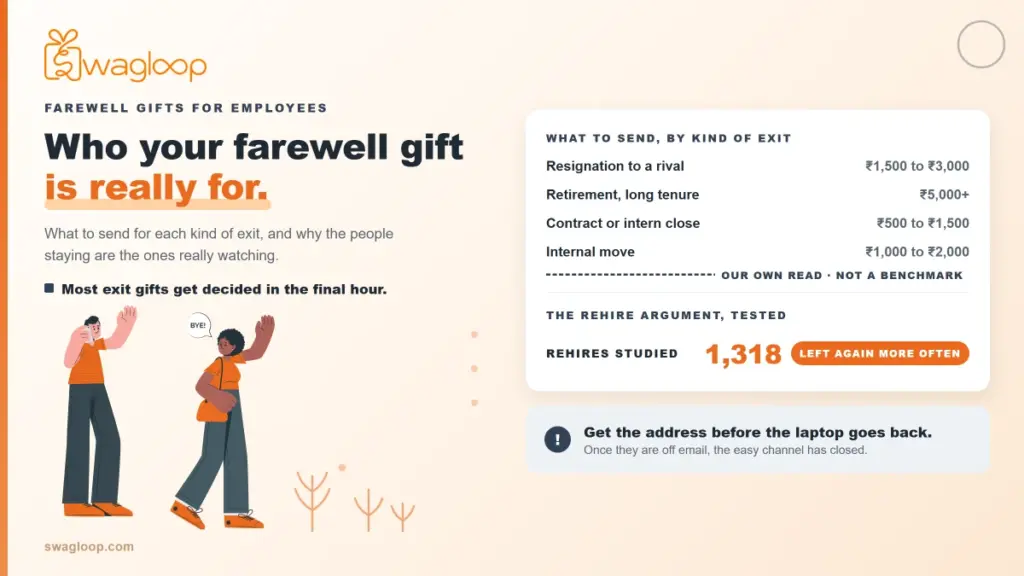
Work in the Journal of Management by Arnold, Van Iddekinge, Campion, Bauer and Campion looked at 1,318 rehired managers and set them against 20,850 outside hires and 8,546 internal promotions from the same organisation, which makes it one of the cleaner comparisons anyone has run on the question. Three findings stand out.
- Year one looked identical: Rehired managers performed about as well as everybody else.
- The gap opened later: Rehires improved less over time than either of the other groups.
- They left again: Second departures were more common, usually for the reasons that drove the first one.
So a gift bought as a down payment on a future rehire rests on thin odds. Send it for better reasons.
Where People Actually Go Next
Here’s the part that matters more for an Indian employer. People who leave you rarely drop out of the industry. They rejoin it almost at once.
EPFO payroll data for July 2025 counted 16.43 lakh members rejoining after an earlier exit, in that single month. The Ministry of Labour and Employment says these members “switched their jobs and re-joined the establishments covered under the ambit of EPFO.”
So the formal workforce kept them, and only the employer changed. Two things follow from that.
- Your story travels fast: The analyst who quit last month already sits in a rival’s office, talking to people who might apply to you.
- It travels to the right people: Recruiters and peers in your own sector hear it first, and they’re exactly the audience you spend money trying to reach.
The same eyes follow work anniversary gifts and every other moment you choose to mark.
What Should You Send When Someone Leaves?
Good farewell gifts for employees do one of three jobs. They mark the time served, they help in the next chapter, or they carry something the team wants to say. Anything else is filler.
The type of exit should drive the pick. Grade matters far less than most teams assume.
| Exit type | What fits | What to leave out | Typical per-head band |
|---|---|---|---|
| Resignation to another company | Quality everyday-carry item, gourmet hamper, a signed note from the team | Anything with your logo on it | ₹1,500 to ₹3,000 |
| Retirement or very long tenure | A considered one-off, something for home, a bound book of messages | Standard-issue desk items | ₹5,000+ |
| End of contract, intern, project close | Practical kit they'll use while job-hunting, a written reference | Sentimental keepsakes | ₹500 to ₹1,500 |
| Internal move or relocation | Something tied to the new city or role | A goodbye framing, they haven't gone | ₹1,000 to ₹2,000 |
| Involuntary exit | Restrained and practical, or nothing at all | Celebration language, team ceremony | Case by case |
Those bands are what we see working across Indian companies. They aren’t a published benchmark, so let your own per-head gifting budget win any argument with them.
The Safe Middle Ground
When you can’t read the relationship well, go for food or good basics. A decent hamper gets eaten and remembered warmly. A branded mug stays in the office kitchen.
Skip anything that needs you to know their taste in home decor.
Let Them Pick Where You Can
Guessing gets worse the less you know someone. It fails fastest when teams split their picks by gender, which search data suggests happens a lot.
Hand over a small approved set and let employees choose instead. Choice also solves sizing, the top reason clothing gifts never get worn.
What Should You Keep Out of It?
A few categories misfire on exit even though they work fine in March or at Diwali. Worth knowing before someone orders fifty of them.
- Heavily branded merchandise: Your logo on a hoodie suits a new joiner. On a last day it reads as an advert the person now carries into a rival’s office. Custom branded gifts earn their place at onboarding and at festivals.
- Short shelf-life food: Send-offs slip by days. Fresh items don’t survive a moved last working day.
- Alcohol, unless you know the person well: It’s a common default in Indian corporate gifting and a frequent misread.
- Gifts funded by a WhatsApp collection: Someone always pays twice, someone always forgets, and the awkwardness lands on whoever collects.
- A card signed by near-strangers: Twelve signatures from people who never worked with them reads worse than four from the actual team.
The Surplus Stock Trap
Companies with leftover event stock treat exits as a way to clear it. Teams spot surplus inventory at once, and the gesture flips into an insult.
Use the leftovers for internal events instead.
Who Decides and Who Pays?
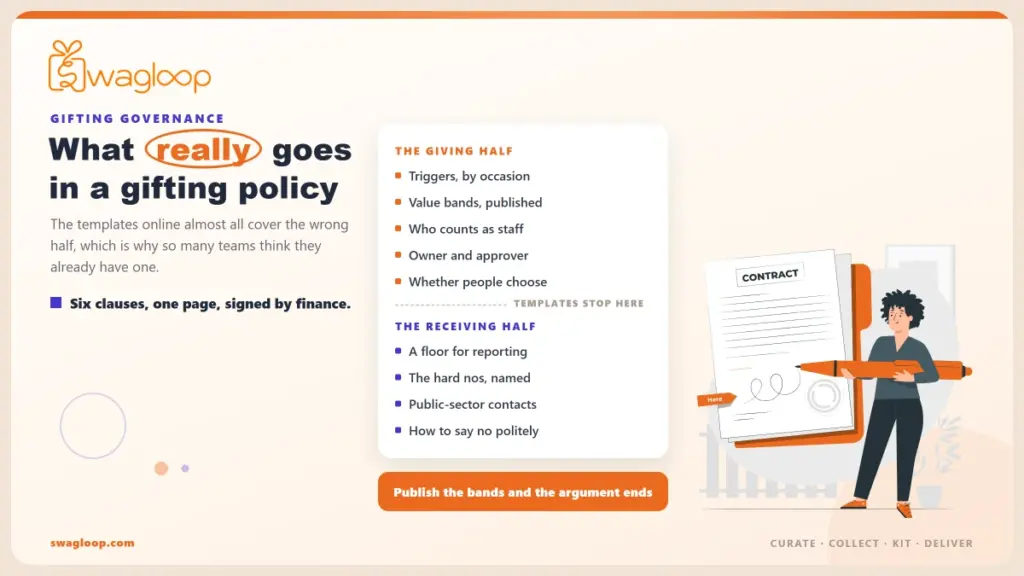
Most companies have no written employee leaving gift policy. So the call falls to whoever likes the person most, and you end up with a ₹6,000 send-off in one team and a card in another, same month, same grade.
A workable policy settles four things.
- Trigger: Which exits get a gift at all.
- Owner: Who buys it. Central HR gives you consistency, the manager gives you relevance.
- Band: What gets spent, tied to exit type rather than to popularity.
- Sign-off: Who approves anything above the band.
Company Money or a Team Collection?
Both, doing different jobs. The company funds the gift so the value holds steady across departments. The team owns the card, the words, and the send-off, because money can’t buy that half and it’s the half people remember.
Trouble starts when the company puts in nothing and colleagues quietly fund a send-off themselves.
The GST Detail Finance Will Raise
Under CGST Section 17(5)(h), input tax credit is blocked on gifts. The Act covers goods “lost, stolen, destroyed, written off or disposed of by way of gift or free samples”.
So you can’t claim credit on the GST you paid. Budget the full amount and don’t let anyone plan around a credit that never lands.
How Does an Exit Gift Sit With Payroll?
Gifts in kind from an employer count as a perquisite in India. From 1 April 2026, gifts, vouchers and tokens from an employer are tax-free up to ₹15,000 a year in total. The limit was ₹5,000 until 31 March 2026. The treatment shifts once someone stops being an employee, because benefits tied to the end of a job sit in a different part of the salary rules.
Two practical notes for whoever runs it.
- Keep the gift out of the full and final settlement. Anything routed through the settlement invites questions the gift doesn’t need to answer.
- Keep an invoice with a clear description so finance isn’t rebuilding the story in an audit.
Former Employees Are a Different Case
Timing matters more than value here. A gift handed over on the last working day is simple. One that turns up three months later, after they’ve joined somewhere else, is another kind of transaction.
Send it before they’re off your books. Where the perquisite rule starts and stops is covered in tax on employee gifts, and your finance team should confirm the current position for your case.
How Do You Run This as a Programme?
Exits aren’t rare at a company of any size. A 300-person firm with normal attrition says goodbye to dozens of people a year, and every one of those goodbyes lands on somebody’s desk as a surprise, which is exactly what makes them expensive and uneven. The fix is a small repeating process.
| One-off scramble | Exit gifting programme | |
|---|---|---|
| Decided | 40 minutes before the send-off | Once, at the start of the year |
| Owned by | Whoever's free | HR, with manager input |
| Cost per head | Highest, retail, no negotiation | Lower, ordered in a batch |
| Consistency | Varies wildly by team | Same band for the same exit type |
| Delivery | Someone drives to a mall | Dispatched to the person, tracked |
| Finance view | Scattered reimbursements | One invoice, one budget line |
How to Hit a Workable Order Size
Here’s the honest constraint. One farewell gift is not a bulk order. Most gifting platforms run to a minimum order quantity, and ours is 40 units per SKU, so buying one gift at a time is the priciest route there is.
Two ways around it that don’t involve warehousing anything.
- Batch by quarter: Order against expected exits every three or four months. Attrition is steady enough at scale to forecast within a fair margin.
- Fold exits into an existing run: Add them to the same order as your new hire welcome kits or a festive campaign. One order clears the minimum and you draw down across the year.
Companies handling gifting for 500+ employees already work this way for onboarding. Exits are the same job pointed the other way.
Get the Address Before the Laptop Goes Back
Nobody plans for this one. Once someone is off the corporate email and the asset handover is done, the easy way to ask where they want the gift sent has closed.
Collect a personal delivery address during the notice period, alongside the rest of the offboarding checklist, and confirm it again in the final week, because people who’ve taken a job in another city often move before the courier ever reaches them and nobody thinks to check until the parcel bounces back. One form field covers it. For remote employee gifting it matters even more, since there’s no desk to leave anything on.
The Send-Off Says More Than the Gift
Go back to that Tuesday and the forty-minute dash to the mall. The gift wasn’t what went wrong. Nobody had decided anything until the last moment, and every person in the room could tell.
Corporate farewell gifts don’t need to be lavish or clever. They need to be decided early, matched to the kind of exit, and handed over while the person is still yours to reach.
Do that and the people staying draw the obvious conclusion about their own turn. Skip it and they draw one anyway.
Most teams run exits, onboarding, and festive gifting as three separate scrambles on one budget. If you’d rather run them as one, our gifting platform was built for exactly that, and we’re happy to look at what your year actually looks like.
Frequently Asked Questions
What should the message on a farewell card say?
Specifics beat warmth here. One concrete thing the person did, named by someone who saw it, outlasts a page of good wishes. Keep it to a few lines, and let the people who worked with them daily write it rather than leadership.
Should a colleague’s departure be announced on LinkedIn?
Let the person post first. Announcing before they’ve shaped their own story takes the moment away from them, and it can complicate a job search still in progress. Once they’ve posted, a warm comment from the company account carries more weight than a separate announcement.
Do alumni gestures a year later make sense?
Occasional and personal works. A note when someone hits a milestone reads as real. A recurring corporate mailer to former staff reads as marketing, and people unsubscribe fast.
What if three people resign in the same week?
Handle each separately, on its own day. Batching send-offs into a single event saves an hour and tells everyone watching that departures have become routine admin, which is rarely the message you want. Order the gifts together by all means, since purchasing is a different decision from ceremony.
Should the manager or a colleague present it?
Reporting managers carry more weight, because their absence gets noticed and read as indifference. A close colleague can speak alongside them. Avoid handing the job to whoever happens to be free, which is the most common version and the flattest.