

A ₹1,000 gift card takes about four minutes to send to two hundred people. A ₹1,000 gift takes a week and a spreadsheet of addresses.
So the card wins, and most HR teams pick it at least once. Then somebody asks in January what people got at Diwali. Nobody in the room remembers.
Gift cards versus gifts for employees is a real decision with real trade-offs, and the answer changes with the occasion. Let’s go through where each one earns its place, what Indian tax does with them, and the third route most teams never price.
Why do HR teams reach for gift cards first?
Because a voucher removes every hard part of gifting at once. No sizes, no addresses, no breakage, no leftover stock in a cupboard.
We sell gifts rather than vouchers, so read this section knowing that. The case for cards is still strong.
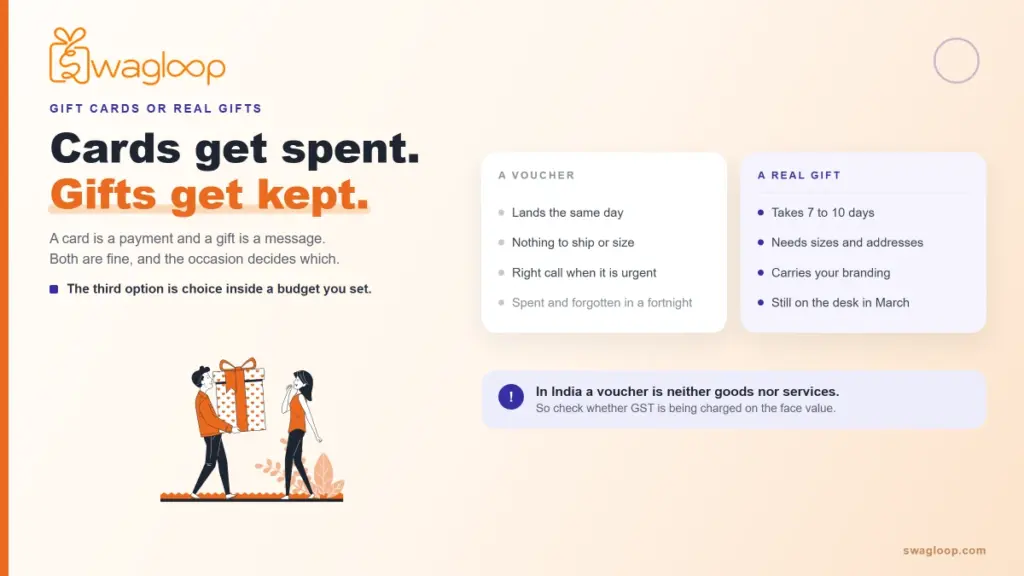
- Speed: A voucher lands the same day, which a physical gift cannot manage at any budget.
- No wrong choices: The person picks whatever they want, so nothing gets regifted.
- One line in the books: No shipping, no packing, no damaged parcels to replace.
- Works everywhere: A digital card reaches a home office in Indore as fast as a desk in Gurgaon.
Most of the pages arguing this online are published by companies that sell gift cards. Worth knowing while you read them.
The honest summary is that vouchers solve the sender’s problems very well. Whether they solve the recipient’s is a different question.
What does a gift card signal to the person opening it?
It says somebody remembered the date. It does not always say somebody thought about them.
A voucher carries no information about the person receiving it. Everyone gets the same rectangle for the same amount, so the gesture is fair and completely anonymous. That is the trade you are making.
Research on gift-giving points the same way. In a Journal of Experimental Social Psychology study, recipients appreciated gifts they had asked for more than surprises, while givers assumed both landed equally well. A voucher is the purest version of “you decide”, and it also removes any evidence that you thought about the choice.
Two things happen to a card after it arrives.
- It gets spent on something ordinary within a fortnight, like groceries or a phone bill.
- It sits unused in an inbox until somebody remembers it in March.
Neither outcome leaves anything behind. A bottle on a desk or a jacket somebody wears in winter keeps working for months, which is why work anniversary gifts lean physical almost every time.
A card is a payment. A gift is a message. Both are fine, and only one of them gets remembered in the exit interview.
How does India treat vouchers and gifts at tax time?
Differently from cash, and more simply than most teams expect. The important line falls between money and everything else.
Cash and bank transfers are salary. They go on the payslip and get taxed from the first rupee, whatever you call them internally.
Gifts and vouchers sit in perquisite territory instead, where the Income Tax Department treats a benefit given in kind under different rules from money paid over. There is a yearly ceiling per employee, and the full mechanics sit in tax on employee gifts.
| Claim on the product | What it actually covers | What to ask the vendor for |
|---|---|---|
| Ecomark | India's official eco-label, judged cradle to grave | The licence, and the product category it covers |
| FSC | Paper and wood tracked through the supply chain | The chain-of-custody code on your invoice |
| GOTS | Organic textiles at every processing step | The certificate of the firm that made the item |
| GRS | Recycled content in a material | The percentage, and who checked it |
| "Eco-friendly" printed on the box | Nothing at all | A certificate, which usually ends the chat |
The GST point almost nobody has updated
That last row changed recently and plenty of finance teams have not caught up.
The CBIC clarified in Circular 243/37/2024-GST that transactions in vouchers are treated as neither a supply of goods nor a supply of services.
Two things still attract GST, and the voucher itself is not among them.
- Whatever the voucher finally buys, taxed like any other supply.
- Any service or handling fee the issuer charges you for providing it.
So if a quote shows GST on the voucher value itself, ask about it.
None of this is tax advice, and we file nothing. Put the numbers in front of whoever signs your returns before a large run.
When is a gift card the right call?
More often than a gifting company usually admits. Four situations where a voucher is the better answer, and we would say so to a client.
- You have under a week: Nothing physical ships and arrives across India that fast, so a card is the only option that lands on time.
- The group is tiny and senior: Five people who each earn well are hard to buy for, and a generous voucher beats a guess.
- It is a performance reward: Somebody who hit a sales number wants the reward rather than a keepsake with a logo on it.
- Preferences are wildly mixed: A group spanning very different ages, diets and tastes is where a card stops being lazy and starts being sensible.
Notice what those four have in common. Each one is either urgent or individual.
Company-wide festive gifting is neither. It is planned months ahead and everybody receives at once, which is exactly where a voucher wastes its one advantage. Scattered teams change the maths a little, and remote employee gifting is mostly an address problem rather than a product one.
What is the third option most teams miss?
Choice inside a set you already approved. You fix the budget and the shortlist, and each person picks their own gift from it.
That keeps the control of a bulk order and the feel of a personal one.
Here is how a run works end to end.
- Set the brief and the per-head number: Occasion, headcount and budget, before any product enters the conversation.
- Approve a small set of options: Three or four packs at the same price, each one you would happily send.
- Share one link: Each person picks their pack and size, then enters their own address.
- Close the window: Set a date and dispatch on what you have rather than waiting on the last few replies.
- Track to the doorstep: Every parcel carries tracking, so you know what landed.
Why this beats both other options
A voucher gives choice and no thought. A guessed gift gives thought and no fit. Choice inside an approved set gives you both, because you did the curation and they did the picking.
- Spend cannot drift: Every option sits at the same per-head number.
- Sizes come from the person wearing it: Which removes the single largest source of waste in apparel gifting.
- Addresses arrive with the choice: The same form collects both, so nothing gets chased.
Describing an occasion and a budget and getting a small set of AI-curated packs back is faster than browsing a catalogue of thousands, and the model itself is covered in letting employees choose.
A Bengaluru software firm we work with had sent ₹1,000 vouchers two years running. On the third year they ran the same budget as a choice-based pack, and 178 of 220 people picked within four days. Their people lead said the difference was that this time she got messages about the gift.
How do you decide for your next gifting run?
Match the format to the occasion rather than to your calendar pressure. Six common situations cover most of what an Indian company sends in a year.
| Ask this | A real answer sounds like | A weak answer sounds like |
|---|---|---|
| Which certificate does this item hold? | A named standard and a licence number | Our whole range is eco-friendly |
| Can you send it across? | A PDF naming the company and product | The supplier has it, we can check |
| What is the packaging made of? | Named board, filler and tape | Fully sustainable packaging |
| What happens to unused stock? | A clear answer on returns or reuse | We can store it for you |
| Where is it made? | A place and a factory relationship | Through our partner network |
Two rows deserve a second look. New-hire gifting is the one most teams get wrong with a voucher, since day one is when a physical kit does the most work, which is the whole point of new hire welcome kits.
The festive row is where the money sits. Diwali is the single date most Indian companies gift the whole team at once, so it is also where a voucher costs you the most recognition for the same spend. Timing and per-head numbers for that run sit in Diwali corporate gifts, and setting the per-head gifting budget first keeps the choice honest.
Conclusion
Pick the format the occasion actually calls for. Send a voucher when speed or individuality is the whole requirement, send a real gift when you want somebody to remember it in six months, and use choice inside a fixed budget when you want both at once. The only bad answer is defaulting to a card every December because addresses feel like work.
Which of your gifting runs this year was a card sent for the sender’s convenience? If you want to price the third option against what you spent last time, see how Swagloop works and set your brief and budget.
Frequently Asked Questions
Can you give an employee a voucher and a gift in the same year?
Both count toward the same yearly total per person, so the combined value is what your finance team tracks. Keep a running sheet across festive, birthday and milestone runs, because separate teams often send without checking each other.
What happens when a voucher expires unused?
Unspent value usually returns to the issuer rather than to you, which makes it the quietest way to waste a gifting budget. Check the expiry terms and the refund position before you buy in bulk.
Do vouchers work for employees in smaller towns?
Redemption is the catch. A brand voucher is only worth its face value where that brand actually operates, so check coverage before sending one company-wide. Physical delivery reaches most pin codes more reliably than a narrow retail network does.
Should the amount be the same across grades?
Flat is easier to defend and easier to run. Tiering works when the gap between levels is large enough that one number cannot serve both ends, and two tiers is the most any team should attempt.
Can a company reimburse an employee instead of sending something?
Reimbursing cash puts the amount closer to salary treatment, which usually defeats the point of gifting it. Check the position with your finance team first, since the tax outcome differs sharply from sending a gift in kind.