The question usually arrives late. A gifting run is approved, the budget is set, and then somebody in finance asks whether this creates a tax problem for the employees or for the company.
Fair question. The answer sits in two different laws.
Tax on corporate gifts to employees in India runs through the income tax rules on one side and GST on the other, and the two use different thresholds for different reasons. Once you know which number applies where, planning a clean run takes about ten minutes. Below is what each rule says, what it means for a per-head budget, and where teams trip up.
One thing to be clear about first. We plan and run gifting campaigns for companies. We are not tax advisers, and nothing here replaces a conversation with your CA before you file.
Are corporate gifts to employees taxable in India?
Sometimes, and it depends which threshold you cross. A modest gift usually creates no tax event for the employee and no GST event for the company. A generous one can create both.
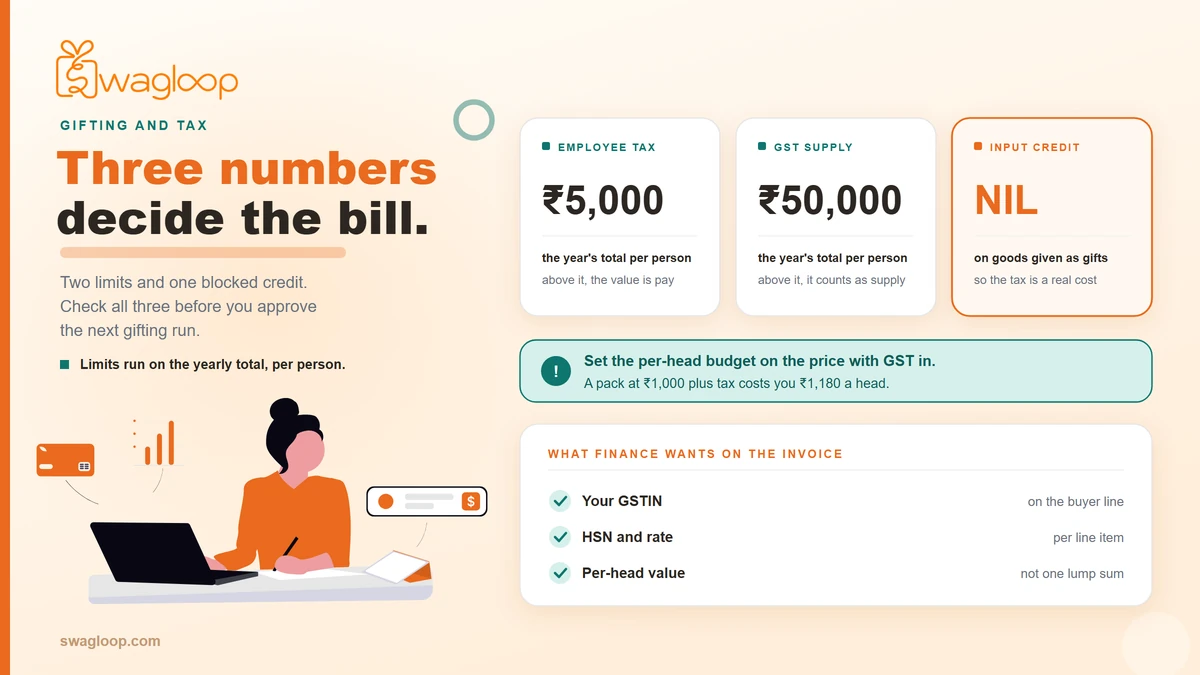
Three numbers do the work.
| The number | Which law | What it decides |
|---|---|---|
| Rs 5,000 | Income tax, Rule 3(7)(iv) | Whether the gift’s value gets added to the employee’s taxable pay |
| Rs 50,000 | GST, Schedule I entry 2 | Whether the gift counts as a supply the company owes GST on |
| Nil | GST, Section 17(5)(h) | Input tax credit you can claim on goods given away as gifts |
Read the third row carefully, because it is the one that changes your budget rather than your paperwork. The GST you pay when buying the gifts is generally not recoverable, so the real cost per head is the price including tax.
The first two rows are per employee, per financial year, on the total. Not per occasion. That distinction is the single most common mistake we see in gifting plans.
What does the ₹5,000 rule actually cover?
Gifts in kind, valued for the year as a whole. The income tax rules treat the value of a gift, voucher or token from an employer as a perquisite, and Rule 3(7)(iv) sets the value at nil where the aggregate for the year stays below ₹5,000.
So a ₹1,200 Diwali hamper on its own creates nothing to report. A ₹6,000 hamper does.
There is a genuine split in how practitioners read what happens once you cross the line. The rule words the relief as applying when the aggregate is below ₹5,000, which some read as the whole amount becoming a perquisite at that point, and others read as only the excess being taxable. Ask your CA which position your company takes before you sign off a per-head budget near the line. Sitting comfortably under it avoids the argument entirely.
Where the yearly total catches teams out
Nobody plans to cross ₹5,000. Teams cross it by running three separate occasions that each looked small.
Here is an illustration of how it happens across one year for a single employee.
| Occasion | Gift | Value | Running total |
|---|---|---|---|
| April, new joiner | Welcome kit | Rs 1,800 | Rs 1,800 |
| August, work anniversary | Recognition gift | Rs 1,500 | Rs 3,300 |
| October, Diwali | Festive hamper | Rs 1,400 | Rs 4,700 |
| December, year end | Branded jacket | Rs 1,600 | Rs 6,300 |
Each decision was reasonable. The fourth one moved that employee over the line, and whoever runs payroll finds out in January.
The fix is one running total per person. Different teams own different occasions, and they usually do, so somebody has to see the whole year in one view. Teams handling gifting for 500+ employees need that as a report.
What counts as a gift and what does not
The rule covers gifts in kind. Cash and anything that behaves like cash gets treated as pay, in full, with no threshold.
- A physical gift or hamper: Covered by the ₹5,000 aggregate.
- A voucher or token in place of a gift: Also covered, and worth its own look in section four.
- Cash, a bank transfer or a cash-equivalent bonus: Salary. Taxed in full through payroll.
- A performance incentive: Salary, whatever it is called internally.
Renaming a bonus as a gift changes nothing. The test is what the employee receives.
Can you claim GST input credit on employee gifts?
Generally no, and this is the number that quietly reshapes your budget. Section 17(5)(h) of the CGST Act blocks input tax credit on goods disposed of by way of gift or free samples.
The GST on your gifting invoice becomes a cost you carry.
Work an example. A pack priced at ₹1,000 plus 18% GST costs you ₹1,180 per head, and all ₹1,180 lands in your gifting cost. Budget on ₹1,000 and a 200-person run is short by ₹36,000.
Plan every gifting budget on the GST-inclusive figure. It is the most useful practical takeaway on this page, and it is the one most per-head budgets we see have not accounted for. Our note on corporate gifting budget per employee works from inclusive numbers for exactly this reason.
The ₹50,000 line in Schedule I
Separate rule, separate purpose. GST normally treats an employer and employee as related persons, which can make a free transfer between them a supply even with no money changing hands.
Schedule I, entry 2 of the CGST Act carves out a proviso. Gifts not exceeding ₹50,000 in value in a financial year from an employer to an employee are not treated as a supply of goods or services.
- Under ₹50,000 for the year: No supply, so no GST output liability on the gift.
- Over ₹50,000: The excess falls into supply and the position changes, including on credit.
Almost every employee gifting programme sits far below ₹50,000. It becomes a live question for senior leadership gifting, long-service awards at the top end, and one-off high-value recognition. Worth knowing the line is there before somebody proposes a ₹75,000 milestone gift.
How are gift vouchers treated differently from physical gifts?
On the income tax side they sit inside the same ₹5,000 aggregate as a physical gift. On the GST side they have their own history, and the treatment of vouchers has moved more than once.
Two things are settled enough to plan around.
- For the employee, a voucher given in place of a gift counts toward the same yearly total as a hamper would.
- For the company, voucher transactions are treated differently from buying goods, so do not assume the input credit position matches your physical-gift purchases.
The rest deserves a specific question to your CA rather than a general answer here, because voucher treatment has been clarified and re-clarified and the detail depends on how the voucher is structured.
Worth noting the practical trade-off too. Vouchers are simple to distribute and land as pay-adjacent for many recipients, which is part of why employee choice gifting tends to land better than a voucher of the same value. People remember a gift they picked. A voucher gets spent on groceries and forgotten.
What does your finance team need on the invoice?
A proper tax invoice, with enough detail to sit in the books without follow-up questions. Getting this right the first time is the difference between a clean file and three emails a week later.
Ask your gifting supplier for the following.
- A GST tax invoice, addressed to your registered entity name and with your GSTIN on it.
- The supplier’s GSTIN, invoice number and date.
- HSN codes and the GST rate applied per line item.
- A line-item breakdown, so the per-head value is visible rather than buried in one lump sum.
- Delivery and quantity detail matching the purchase order.
The per-head visibility is the one to insist on. Without it you cannot evidence the ₹5,000 position per employee, and you cannot answer a payroll query without going back to the vendor.
Custom work adds one more thing to watch. Branding, packaging and kitting charges may sit on separate lines at different rates, so ask how a custom branded gifts order will be invoiced before it ships rather than after.
How do you plan a gifting run that stays clean?
Set the per-head budget on the GST-inclusive price, track the yearly total per person, and keep documents that match each other. That covers almost every question finance will ask.
Run it in this order.
- Decide the inclusive per-head figure. Work backwards from what you can spend with tax in, then pick gifts to fit.
- Check the person’s running total before you approve the occasion.
- Raise a purchase order that matches the quantity and the per-head value you approved, line for line, so the invoice has something to reconcile against later.
- Collect the tax invoice with per-head detail on delivery and file it with the PO.
- Tell payroll early. Anything near a threshold goes to them before the gifts ship.
Step two is where the work actually is. Occasions get owned by different people, so the employee welcome kit sits with onboarding while work anniversary gifts sit with the people team and Diwali corporate gifts sit with whoever runs the festive campaign. Three owners, one employee, one yearly total.
What we see in practice. Companies that plan the whole year at once, rather than occasion by occasion, almost never run into a threshold problem. The ones who buy reactively in October are the ones asking payroll questions in January.
Before you approve the next run
You now have the three numbers and the order to check them in. ₹5,000 for the employee, ₹50,000 for the supply question, and no input credit on the GST you pay.
One more time on the limitation. Confirm your position with your CA, because rules change, readings differ, and your auditor’s view is the one that counts in the end.
Would you rather the yearly per-head total was tracked for you than chased across three spreadsheets? See how SwagLoop runs a gifting programme, from the brief through to invoicing your finance team accepts first time.
Frequently Asked Questions
Do gifts to interns or contract staff follow the same rule?
The employee perquisite rules apply to an employment relationship. Gifts to contractors, consultants and agency staff usually sit in a different bucket for both tax and GST, so check the status of each group with your CA before treating them the same way.
Who actually pays the tax if a gift crosses the limit?
The employee does, through payroll. The value gets added to taxable salary and the usual salary deduction applies on the higher figure, which is why payroll needs to know before the gift ships rather than at year end.
Should the gift value appear on the employee’s payslip?
Where a gift becomes taxable, its value flows through the salary computation and shows up in the year’s figures. Handling it quietly and late tends to create more questions from employees than showing it clearly.
Does the minimum order quantity change the tax position?
Order size affects your unit price and nothing else. Buying 200 units at a lower per-unit price actually helps, because a smaller per-head value keeps more room under the yearly limit for later occasions.
Are gifts to clients treated the same as gifts to employees?
Client gifts sit outside the employee perquisite rules entirely and are usually treated as a business promotion expense. The blocked input credit on gifts still applies, so the GST is a cost there too.