

A new hire logs in on day one and a box is waiting at their door. Inside is a hoodie two sizes too big, a pen that runs out by week two, and a mug they already own. It is a kind gesture that mostly ends up in a drawer.
Good employee welcome kit ideas are the ones people actually keep and use. The ones that only look full in a photo get tossed by the weekend. A kit that fits the person tells them the company thought about them before they even started.
Below, we cover why kits matter, what gets kept versus binned, the ideas worth your budget, how much to spend, and how to run it for every new hire without the busywork.
Why a Welcome Kit Actually Matters
A welcome kit is the first thing a company physically hands a new hire, and first things set the tone. Done well, it signals the person is valued and belongs here.
That signal does real work. McKinsey found that people who quit most often pointed to not feeling valued by their organization or a lack of belonging, above pay or hours. A welcome kit will not fix culture on its own, but it is one early moment where a new hire feels the company noticed them and made an effort.
A good kit does a few things at once.
- It says welcome before words do: The box lands before the first meeting, so the new hire feels expected.
- It shows real thought: Items that fit their role and size read as effort rather than a bulk order.
- It builds belonging early: Branded pieces they enjoy using make them feel part of the team from day one.
None of this needs a big budget. It needs attention to who the person is and what they will actually use.
Get this moment right and the rest of onboarding starts on the front foot. Get it wrong and the first thing your company communicates is that nobody looked closely.
What New Hires Keep, and What Gets Binned
The line between a kit that gets kept and one that gets binned comes down to fit and daily use. People hold on to things they reach for every day and things that feel made for them. They quietly bin generic filler and anything the wrong size.
| Gets kept | Gets binned |
|---|---|
| A quality bottle or tumbler used daily | A flimsy pen that dies in a week |
| Apparel in the size they picked | A hoodie in one guessed size |
| A tech accessory that solves a real need | Plastic trinkets and packing filler |
| A handwritten note from the team | A generic printed leaflet |
The pattern is simple. Daily use and personal fit survive. Guesswork and padding get tossed. The logo on the box never changes that, because what sits inside decides whether it gets used.
Think about your own desk for a second. The mug you actually use is almost certainly one that someone picked well, or one you chose yourself. Every idea in the next section sits on the keep side of that line.
Employee Welcome Kit Ideas That Earn Their Place
The best employee welcome kit ideas earn their place by being useful, personal, or both. You do not need forty items. Five or six good ones beat a box stuffed with padding every time.
Build the kit from these five slots.
- Everyday carry: A quality insulated bottle, a tumbler, or a sturdy tote the new hire will use well outside work too.
- Desk and tech: A wireless charger, a laptop sleeve, or good headphones for focus, matched to how the person actually works.
- Apparel they size themselves: A soft t-shirt or hoodie where the new hire picks the fit, so it gets worn instead of shelved.
- A personal touch: A short handwritten note from the manager or team. It costs almost nothing and gets remembered longer than anything else in the box.
- The unboxing: Clean packaging and a card, so opening it feels intentional. Custom branding here does far more than a logo slapped on every single item.
One move lifts a kit from generic to memorable. Tailor one slot to the role. A developer gets a better laptop stand, a field sales hire gets a rugged bottle, a new designer gets a proper notebook. Same budget and same structure, but the box now feels chosen for the job they were hired to do.
Steer clear of the usual filler while you are at it. Branded stress balls, throwaway earphones, and single-use plastic add bulk and little else. A lighter kit of things people keep will always read better than a heavy one they quietly empty into the bin.
You do not have to assemble all of this by hand. A curated set built from your brief and budget, the idea behind AI-curated corporate gifting, turns those five slots into a short list you approve in one sitting.
How Much Should a Welcome Kit Cost?
Most Indian teams spend ₹1,000 to ₹2,500 on a new-hire welcome kit. Senior and leadership hires often get more. One ceiling worth knowing is the tax line. From 1 April 2026, gifts, vouchers and tokens from an employer are tax-free up to ₹15,000 a year in total. The limit was ₹5,000 until 31 March 2026.
| Kit tier | Per-kit range | What fits inside |
|---|---|---|
| Essentials | ₹800 to ₹1200 | A bottle or mug, a notebook, a branded pen, a note |
| Standard | ₹1200 to ₹2500 | The essentials plus apparel they size and one tech accessory |
| Premium | ₹3000 and up | A senior or leadership kit built around one standout item |
Spend where it gets noticed and used. The corporate gifting budget per employee shifts with the role and the occasion, so a graduate joiner and a senior hire rarely belong in the same tier. Match the kit to the moment and the money works harder.
A simple rule helps you split it. Put most of the budget into the one item the new hire will judge the kit by, usually the apparel or the bottle, and keep the rest light. A ₹1,500 kit with one standout piece beats a ₹2,500 kit of five forgettable ones.
Let New Hires Pick Their Size and Style
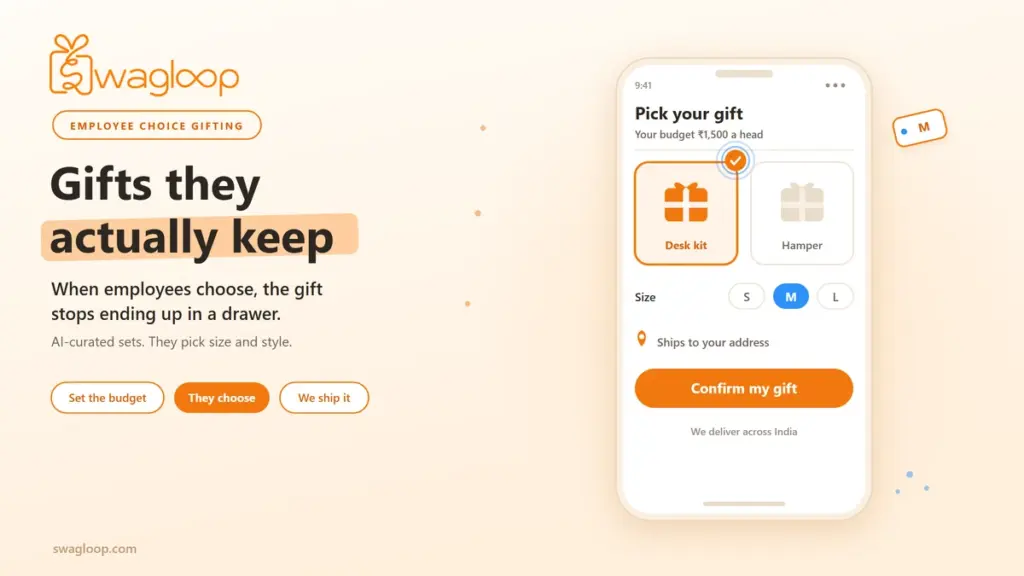
The fastest way to make a kit get kept is to let the new hire choose. Wrong size is the top reason apparel ends up unworn, and guessing never solves it. When the person picks their own size and style, the gift actually gets used.
People expect this now. McKinsey’s research shows most people expect personalized experiences and feel let down without them, at work as much as anywhere else.
Letting people choose fixes three things at once.
- Fit: Apparel arrives in a size the person will actually wear.
- Relevance: They pick the color or style they like, so it feels like theirs.
- Waste: Fewer returns and reorders, so more of the budget lands in the box.
Choice is simple to run. The new hire opens a link, picks size and variant, and enters their own address, the same flow behind employee choice gifting at any headcount.
The result is easy to picture. Instead of a stack of unworn large tees, every hire wears the size they asked for, and the reorder pile that used to fill a cupboard never forms in the first place.
Running New-Hire Kits Without the Busywork
New hires do not arrive on one tidy date. They join in ones and twos, all year, and often from home. Running a kit for each one by hand eats your week, so the real win is a repeatable flow you set up once.
A repeatable new-hire kit runs in five steps.
- Set the kit and budget once: Approve the tier and contents, so every joiner gets the same standard.
- Trigger it on confirmation: Kick off the kit as soon as the hire signs, rather than the week they start.
- Let the hire pick and self-address: They choose size and enter their address through a link.
- Ship it to land before day one: Aim for the kit to arrive a day or two ahead, anywhere in India.
- Brand and track it: Custom branding stays consistent, and you watch every delivery in one place.
Remote hires raise the stakes. A new joiner in another city has no office desk to decorate and no team to hand them a bag on day one. The kit is their welcome, and getting it to their door before the first standup, anywhere in India, does the job a physical office used to do.
Handled this way, onboarding gifting stops being a monthly scramble. Swag automation and PAN India delivery do the legwork, which is what employee gifting management looks like when a corporate gifting platform owns the flow from brief to doorstep.
Conclusion
A welcome kit is a small budget line with an outsized first impression. Done right, it pays for itself in how the first week feels. Get the fit right, spend where it shows, and let the new hire pick, and the box becomes something they keep on their desk. Ready to send new hires a kit they actually use? See how Swagloop builds welcome kits your team picks, sizes, and receives before day one.
Frequently Asked Questions
Can you send a welcome kit for just one new hire, or is there a minimum?
Most platforms set a minimum order, often around 40 units, so single kits cost more per piece. For a steady flow of hires, many teams pre-approve a kit and draw against it as people join. That keeps the per-kit cost sensible even for one joiner at a time.
Can a welcome kit be eco-friendly?
Sustainable kits work well and land nicely with newer hires. Swap plastic filler for recycled packaging, a steel bottle, and organic-cotton apparel. Fewer, better items cut waste on their own, so a tight curated kit is often the greener choice anyway.
Who in the company should own the welcome kit?
Onboarding kits usually sit with HR or the people team, sometimes with an office manager. What helps most is one clear owner who sets the standard, so kits do not vary by whoever remembered to order that week.
Should you refresh what’s in the welcome kit over time?
Reviewing the kit once or twice a year keeps it current. Tastes shift, and last year’s popular item can feel stale fast. A quick look at what new hires actually use tells you what to keep and what to swap out.
Do welcome kits work for interns and contract hires too?
A smaller kit suits interns and short-term hires well. Even a bottle, a note, and a branded tee makes them feel part of the team. You can scale the contents to the role while keeping the gesture the same for everyone.